Supplement · graded by use, three uses
MitoQ (Mitoquinone Mesylate)
Brachial artery flow-mediated dilation in older adults.
Grade C: human trials exist, but they are small, mixed or not yet repeated. This is not a finding that it does not work. How to read a grade →
This is a form of CoQ10 built to get into the energy centers of cells. In two tiny studies, blood vessels in older adults widened better after taking 20 mg a day. That is a measurement of blood vessel health, not proof of fewer heart problems. In healthy older adults, it did not improve physical function. It did not improve endurance exercise either.
The C belongs to one of the three uses graded on this record. The other two carry their own letters.
As studied, and the trials
Rossman et al. (Hypertension, 2018; PMID PubMed ID: the permanent number the US National Library of Medicine gives a published paper. Each one links to that paper's record on PubMed. 29661838): 20 older adults with impaired endothelial function, 20 mg/day for 6 weeks in a double-blind Neither the participants nor the people assessing them know who received the real treatment until the trial ends. crossover; flow-mediated dilation 42 percent higher than after placebo An inactive substitute made to look like the real treatment, so participants cannot tell which one they received., with an industry contract from the manufacturer stated beside the letter. Kirkman et al. (Am J Physiol Renal Physiol, 2023; PMID 37560769): an 18-patient pilot in chronic kidney disease, 4 weeks; flow-mediated dilation improved against placebo (p = 0.04), but the groups started apart (2.4 against 4.2 percent) and part of the difference is the placebo group falling. Flow-mediated dilation predicts cardiovascular events in cohort studies An observational study that follows a group of people over time and compares what happens to them., but no trial has shown that raising it with a treatment prevents an event, so it is not an established stand-in for a clinical outcome under the B definition. Two small trials on a marker that does not qualify for B: C.
As studied, and the trials
Murray et al. (J Physiol, 2026; PMID 41733122): 6 weeks of 20 mg/day in 18 healthy older adults, no convincing effect on any measure of physical function; the authors' own conclusion is that the mouse findings did not translate. Tested at the record's dose and no benefit: D on Route 2 Human randomized trials have been run and did not show benefit on the stated outcome. One of the two routes to the lowest letter on EBL's scale., at low certainty given the trial's size.
As studied, and the trials
Tested without benefit. Gonzalo-Skok et al. (Sports Med Open, 2024; PMID 38981985) pooled 8 trials and found no improvement in endurance performance. Shill et al. (J Physiol, 2016; PMID 27501153) found no effect on training adaptations or maximal oxygen uptake, and Broome et al. (Redox Biol, 2022; PMID 35623315) found VO2peak and time-trial gains no different from placebo, in a trial co-funded with the manufacturer. Broome et al. (Appl Physiol Nutr Metab, 2022; PMID 35201920): no effect on soreness or strength recovery. Hughes et al. (Physiol Rep, 2023; PMID 38061764): a single 80 mg dose lowered VO2max The most oxygen the body can use during all-out exercise, a standard measure of aerobic fitness. in nine inactive women, a possible harm at a higher dose. D on Route 2.
Read the grade that matches your goal. How EBL grades by use →
A letter describes the human evidence, not the product, the manufacturer, or the ingredient's worth.
See the full evidence record →Funding: Both trials this Grade C for Brachial artery flow-mediated dilation in older adults rests on were funded by industry or funders the reports do not identify: Rossman 2018, University of Colorado Boulder (PMID 29661838) by the maker of the product it tested; Kirkman 2023, Virginia Commonwealth University (PMID 37560769) by a funder the indexed report does not name. The funder's role in design and analysis is not stated here, because the full trial reports could not be read. The letter is what the trials support under the grading rules; the funding is stated here so it can be weighed alongside it.
Brachial artery flow-mediated dilation in older adults at 20 mg a day, two tiny randomized trials on a surrogate endpoint A lab value or measurement used in place of the outcome that matters, such as LDL cholesterol standing in for heart attacks. Moving a surrogate does not always move the outcome..
Why this gradeGrade C, small or unreplicated trials. The reasoning, and what the grade does not cover.
Grade C, the record's best use: brachial artery flow-mediated dilation at 20 mg/day, improved against placebo in Rossman et al. (Hypertension, 2018; PMID 29661838), 20 older adults, and in Kirkman et al. (Am J Physiol Renal Physiol, 2023; PMID 37560769), an 18-patient kidney disease pilot whose groups started apart.
WHY NOT Bthe B definition admits a biomarker only when it is an established stand-in for a clinical outcome, such as HbA1c A blood test that reflects average blood sugar over the previous two to three months., LDL Low-density lipoprotein cholesterol, the cholesterol fraction most closely tied to plaque in the arteries., blood pressure or bone density. Flow-mediated dilation predicts cardiovascular events in cohorts (Ras et al., Int J Cardiol, 2013; PMID 23041097), but no trial has shown that raising it with a treatment prevents one. Listed beneath it: physical function in healthy older adults and endurance performance, tested at the same dose without benefit, D on Route 2.
WHAT THIS GRADE DOES NOT COVERblood pressure, heart attack, stroke or any clinical event, which no trial measured; and doses other than 20 mg/day.
A grade describes the human evidence for a named use. It is not advice, and it is not a judgment on any individual prescription. How the letters are decided →
Who responds: this record's trial reading reports no subgroup that identifies who responds.
As studied: dose, form, population and duration for every use
A grade describes the intervention that was tested. Where the product on the shelf differs from it, this says so.
How this letter has changed · latest: October 2026 · Upgraded
Rossman et al. (Hypertension, 2018; PMID 29661838) and Kirkman et al. (Am J Physiol Renal Physiol, 2023; PMID 37560769), independent groups at 20 mg/day, both found flow-mediated dilation improved against placebo. The use was held at C because the populations differed and the marker is not a clinical outcome. The editor decided that a replicated The same finding reproduced by a separate research group. A result seen once can be chance or bias; a replicated one is harder to explain away. randomized effect on a measured physiological marker carries B, and that the B definition does not require the replicating trials to share a population. The letter is capped at B because no trial measured a cardiovascular event. Editor decision, October 2026 (Arnold Sandlow, D.C.).PMID 29661838 PMID 37560769
Earlier in October the use was raised to B on Rossman et al. (Hypertension, 2018; PMID 29661838) and Kirkman et al. (Am J Physiol Renal Physiol, 2023; PMID 37560769). On review the editor returned it to C. The B definition admits a biomarker only when it is an established stand-in for a clinical outcome; flow-mediated dilation predicts events in cohorts (Ras et al., Int J Cardiol, 2013; PMID 23041097) but no trial has shown that raising it prevents one. The second trial is an 18-patient pilot whose groups started apart. Editor decision, October 2026 (Arnold Sandlow, D.C.).PMID 23041097 PMID 29661838 PMID 37560769
The best-use line described a mechanism and named no endpoint The outcome a trial measures to decide whether the treatment worked, such as heart attacks, blood pressure or a symptom score.; the C now attaches to brachial flow-mediated dilation in older adults (Rossman et al., 2018; PMID 29661838; Kirkman et al., 2023; PMID 37560769), with the manufacturer's contract and capsule supply stated beside the letter. Added as tested nulls at the record's own 20 mg dose: physical function in healthy older adults (Murray et al., J Physiol, 2026; PMID 41733122) and endurance performance (Gonzalo-Skok et al., 2024; PMID 38981985; Shill et al., 2016; PMID 27501153; Broome et al., 2022; PMID 35623315 and PMID 35201920), each D on Route 2. Added as context: no slowing of Parkinson's disease over a year (Snow et al., 2010; PMID 20568096) and a single 80 mg dose that lowered VO2max (Hughes et al., 2023; PMID 38061764). Broome 2022 is relabeled as an exercise-training trial, and Gane 2010 (PMID 20492507) as a different dose and population. The headline stays C. Applied the written grade definition under the editor's standing instruction of October 2026 (Arnold Sandlow, D.C.).PMID 20492507 PMID 20568096 PMID 27501153 PMID 29661838 PMID 35201920 PMID 35623315 PMID 37560769 PMID 38061764 PMID 38981985 PMID 41733122
The dose field credited "Macpherson et al." alongside the trial it does cite. This record has never cited a Macpherson paper. Its vascular dose comes from Rossman et al. (PMID 29661838), which used 20 mg/day, and its other two citations are Broome (PMID 35623315) and Gane (PMID 20492507). The attribution was removed. Found in the same pass as the glucosamine attribution and for the same reason: a sweep for author names in dose and form fields that do not appear in the record's own citation list. A named author with no identifier beside it is invisible to every gate on this site that checks PMIDs, which is all of them.PMID 29661838 PMID 35623315 PMID 20492507
Every change to a letter on this site is dated and published. The full evidence log →
Commercial disclosure
EBL earns no commission on any supplement it grades. A purchase made through the dispensary link below pays EBL nothing, the practitioner discount goes to you in full. The dispensary is Fullscript, a practitioner dispensary, and many of the professional-grade brands in it are sold mainly through practitioners rather than in health food stores. Grades are assigned by published rubric before any commercial relationship exists and are never influenced by one. Full disclosure.
Grade C reflects two small randomized trials that found flow-mediated dilation improved at 20 mg/day. Flow-mediated dilation is a measured marker of blood vessel function that predicts heart disease, but no trial has shown that raising it with a treatment prevents a heart attack or stroke, so it is not the kind of marker that can carry Grade B. EBL re-grades when new randomized evidence is published.
20 mg/day in the vascular trials (Rossman et al., PMID 29661838; Kirkman et al., PMID 37560769) and in the null trials of physical function and exercise recovery (Murray et al., PMID 41733122; Broome et al., PMID 35201920). The hepatitis C study used 40 or 80 mg (Gane et al., PMID 20492507) and the Parkinson's trial two doses over a year (Snow et al., PMID 20568096).
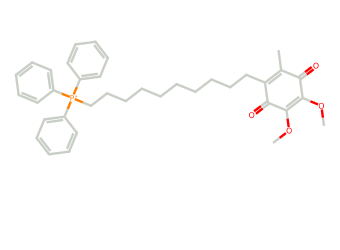
MitoQ is a proprietary compound (mitoquinone mesylate); there is no equivalent generic. It is not interchangeable with CoQ10 or ubiquinol. Available as MitoQ supplement brand.
In the cited vascular trial, capsules were taken once each morning with breakfast (PMID 29661838). In the cited exercise trial, one tablet was taken 30 minutes before breakfast (PMID 35623315).
Checked against the full published reports. What the cited trials did, not a schedule. Every supplement, by trial timing →
How to buy this: quality criteria, not a brand
10–20mg/day (trials used 20mg).
MitoQ is a proprietary compound (mitoquinone mesylate): it is not interchangeable with CoQ10 or ubiquinol.
The MitoQ brand (no equivalent generic exists).
CoQ10/ubiquinol sold as “the same thing”; generic “mitoquinone” of unverified identity.
The grade and these criteria are set only from human trials. Any purchase link is convenience and does not affect the grade.
Pregnancy. Long-term safety is unknown: the trials run to about three months except the one-year Parkinson's trial, which reported no safety problem. Exercise capacity: a single 80 mg dose lowered measured VO2max and maximal ventilation in nine physically inactive women in a crossover trial (Hughes et al., Physiol Rep, 2023; PMID 38061764), a higher dose than the record's, taken one hour before exercise; a possible harm to aerobic capacity that has not been tested at 20 mg.
No drug interaction has been identified in a human trial. MitoQ is a mitochondria-targeted antioxidant, so the chemotherapy and radiotherapy question applies as an oncology decision. Possible additive antiplatelet effect at high doses is mechanistic only.
Mechanism-based, no human interaction study located. The drug interactions described for MitoQ (Mitoquinone Mesylate) are mechanism-based. A PubMed search for human interaction, pharmacokinetic or co-administration studies pairing it with antiplatelet, chemotherapy returned no results in August 2026. The caution stands on pharmacology, not on a trial, and is labeled as such. Basis: pharmacological mechanism, not a human study. Searched PubMed in August 2026: 2 queries, 0 human results.
For vascular use, repeat the same endothelial-function or arterial-stiffness measure used at baseline, such as brachial flow-mediated dilation or pulse-wave velocity where available. Blood pressure can be followed as a conventional clinical measure. Liver enzymes are not an efficacy marker here, only a safety one where there is a separate clinical indication.
Primary evidenceEleven papers, each linked to its PubMed record.
Rossman et al. (Hypertension, 2018; PMID 29661838): 20 healthy adults aged 60 to 79 with impaired endothelial function, 20 mg/day for 6 weeks, randomized double-blind crossover; brachial flow-mediated dilation 42 percent higher than after placebo, aortic stiffness lower only in those with elevated baseline values; funded by NIH, MRC and Wellcome grants with an industry contract from the manufacturer, which supplied the capsules. Kirkman et al. (Am J Physiol Renal Physiol, 2023; PMID 37560769): randomized pilot, 18 patients with chronic kidney disease, 20 mg/day for 4 weeks; flow-mediated dilation improved, exercise capacity did not. Murray et al. (J Physiol, 2026; PMID 41733122): randomized placebo-controlled crossover, 18 healthy adults aged 60 to 79, 20 mg/day for 6 weeks; no convincing effect on physical function, with exploratory subgroup signals in those aged 70 and over; NIH-funded. Gonzalo-Skok et al. (Sports Med Open, 2024; PMID 38981985): meta-analysis A study that pools the numbers from several trials into one combined estimate. of 8 trials, 188 subjects; MitoQ reduced exercise-induced oxidative damage and did not improve endurance performance. Shill et al. (J Physiol, 2016; PMID 27501153): 3 weeks of endurance training with MitoQ or placebo in young men, no difference in training adaptations or maximal oxygen uptake. Broome et al. (Redox Biol, 2022; PMID 35623315): 23 untrained men, 20 mg/day across 3 weeks of interval training; VO2peak, 20 km time trial and mitochondrial content gains no different from placebo, peak power gain larger; funded by a New Zealand government innovation agency in partnership with the manufacturer. Broome et al. (Appl Physiol Nutr Metab, 2022; PMID 35201920): 32 untrained men, 20 mg/day for 14 days; muscle soreness and recovery of maximal strength after eccentric exercise unchanged. Hughes et al. (Physiol Rep, 2023; PMID 38061764): a single 80 mg dose lowered VO2max in nine inactive women. Snow et al. (Mov Disord, 2010; PMID 20568096): 128 newly diagnosed untreated patients with Parkinson's disease, two doses against placebo for 12 months; no difference on any measure of progression; MRC-funded, with developers of the compound among the authors. Gane et al. (Liver Int, 2010; PMID 20492507): phase II, 30 hepatitis C patients, 40 or 80 mg for 28 days; aminotransferases fell within the treated groups, a different dose and population. Ras et al. (Int J Cardiol, 2013; PMID 23041097): 23 cohort studies, 14,753 people; cardiovascular risk about 8 percent lower per 1 point higher flow-mediated dilation, an observational Research that watches what people already do rather than assigning a treatment. It can show that two things travel together, not that one causes the other. association, not a treatment effect. Grade C on flow-mediated dilation: two small randomized trials on a marker that is not an established stand-in for a clinical outcome; functional and exercise outcomes are D on Route 2.
Educational use only · Not medical advice · Starting, stopping or changing any supplement or medication is a decision for your physician
These statements have not been evaluated by the Food and Drug Administration. This product is not intended to diagnose, treat, cure, or prevent any disease. The grade on this page describes the strength of published human trial evidence in the populations studied. It is not a recommendation for any individual and is not medical advice. Starting, stopping or changing any supplement or medication is a decision for your physician.
This page carries a letter. EBL takes no commission, referral fee or payment of any kind on anything it grades. No letter has been bought and none is for sale.
How this is enforced
That is not a promise, it is a build condition. Two checks run on every deploy: one refuses to publish if a commission is claimed on anything graded, the other refuses if a page names a commercial relationship that is not declared in the register. If either fails, this page does not go live. You can read how the checks work, and what they do not cover, on the evidence integrity page.
How EBL searched for the trials (1 search)
The search that was run, what it returned, and what was left out and why, so the absence of evidence can be checked as well as its presence.
(mitoquinone[tiab] OR MitoQ[tiab]) AND randomized controlled trial[pt] AND humans[mesh]Grades move when new trials publish. A free monthly email lists every grade EBL moved, with the reason and the trial behind it: the sign-up is on the Evidence Log →