Some beliefs circulate so widely that nobody remembers where they came from. Each entry here takes one of them, states it as it is commonly held, and sets it beside the human trials that tested the question.
How to read these
A myth has no single source to check. It is folk belief, repeated without attribution, which is what separates these entries from Source Check. So an entry does not name who said it. It names the belief, the question the trials actually asked, and what they found.
Nothing on this page carries a grade. Grades on this site attach to interventions with a defined dose, form and endpointThe outcome a trial measures to decide whether the treatment worked, such as heart attacks, blood pressure or a symptom score.. A belief is not a gradable entity, and no letter is issued here in either direction.
Entries are grouped by subject: exercise, nutrition, supplements, sleep and light, and longevity. A subject appears once it has an entry, so the page shows what has been done rather than what is planned.
Every entry links the identifiers for the papers it rests on. You are meant to open them. If an entry is wrong, the papers are how you would find out.
Exercise
August 2026Outcome substituted
The load on the bar is not what determined how much muscle women built
Widely held on gym floors and in general-audience fitness coverage; no single source
The claim
That heavier weights produce a bulky appearance in women, and that lighter weights with more repetitions preserve a lean or toned one. Two assertions are stacked inside it: that heavier loads produce more muscle size than lighter loads, and that women are at particular risk of that outcome. Both have been tested.
What was tested
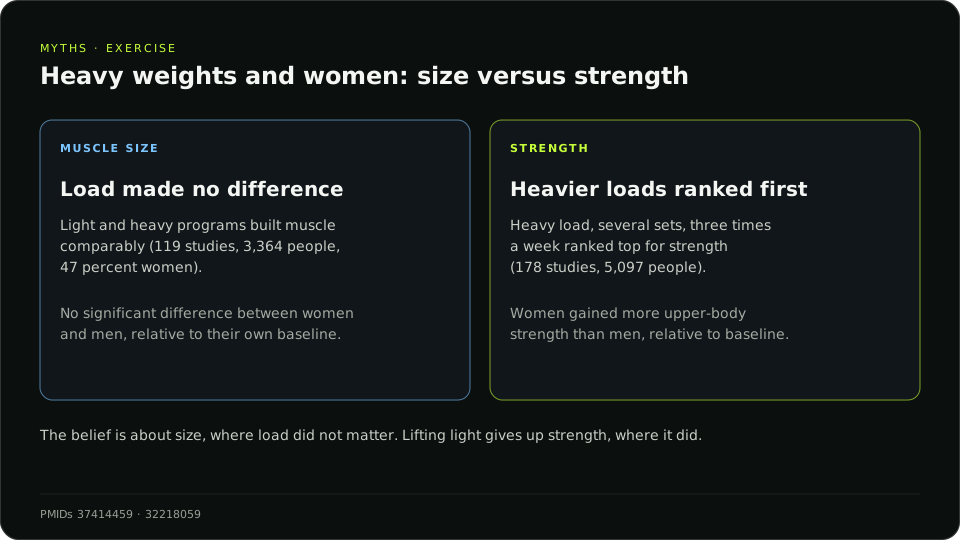
A network meta-analysisA study that pools the numbers from several trials into one combined estimate. compared resistance-training prescriptions against each other on load, set number and weekly frequency. Its strength network covered 178 studies and 5,097 participants, 45 percent of them women; its hypertrophy network covered 119 studies and 3,364 participants, 47 percent women. Higher load was defined as above 80 percent of one-repetition maximum. A separate meta-analysis pooled trials in which men and women followed the same program and compared the change each group made from its own baseline, across 12 hypertrophy outcomes, 19 upper-body strength outcomes and 23 lower-body strength outcomes. A third and earlier meta-analysis compared low against high load in untrained subjects.
Muscle size and strength, side by side. Opens full size in a new tab../assets/images/diagrams/heavy-weights.svg
Verdict
The outcome the claim attributes to heavy load, muscle size, is the outcome on which load did not separate. The outcome on which load did separate, measured strength, is not the outcome the claim is about. Capping the weight therefore does not act on the thing it is meant to act on, and the adaptation it does forfeit is the strength one.
The trials separated on a different outcome than the one the belief is about.
The common rebuttal was also tested
The usual correction offered to this claim is that women cannot build much muscle because they lack the testosterone. That was measured directly and not found. Relative to their own baselines, women in these trials responded as much as men on muscle size, and more on upper-body strength. What differs between the sexes in these datasets is absolute starting mass, not the size of the response. Both the belief and its usual rebuttal fail against the same evidence.
What these trials do not settle
Neither network reports how much absolute lean mass a woman adds over a given number of weeks at a given load, and a finding about relative response does not produce an absolute figure, so none is stated here. Neither was designed around appearance: the endpoints were measured strength and measured muscle cross-section or thickness. A trial randomizing women to matched-volume light and heavy loading, with body-composition imaging as the primary endpointThe one outcome a trial names in advance as its main test. Results on other outcomes carry less weight., would settle the size question directly, and a significant hypertrophy advantage for higher load in that design would change this entry.
Nutrition
October 2026Neither side holds
Seed oils did not raise inflammation in the trials, and did not lower deaths either
Widely repeated in diet and longevity media, in two opposing forms; no single source
The claim
That seed oils (soybean, corn, sunflower, safflower, canola and similar) drive chronic inflammation, heart disease and early death. The opposing belief is held just as widely: that these oils protect the heart, because they lower cholesterol when they replace butter and lard. Both have been put to randomized trials.
What was tested
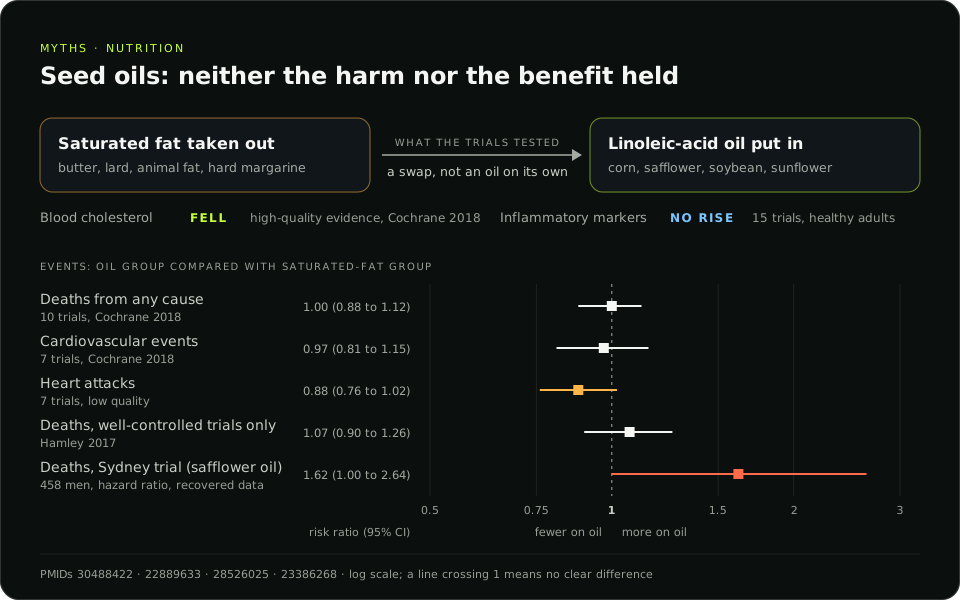
Almost every trial tested a swap rather than an oil on its own: vegetable oil rich in linoleic acid, the main omega-6 fat in seed oils, given in place of saturated fat. Every result below therefore answers what happens when this oil replaces that fat. One Cochrane review pooled 19 randomized trials (6,461 people, one to eight years) of higher against lower omega-6 intake; 12 of them tested linoleic acid and 7 tested gamma-linolenic acid supplements. A second Cochrane review pooled 15 trials (56,675 people) that cut saturated fat for at least two years. Two older diet-heart trials, in Sydney and in Minnesota, were reanalyzed decades later from recovered original data. A further reanalysis separated the trials whose arms differed only in the fat from those that also changed other things. A systematic reviewA review that searches for every study on a question using a method set in advance, then assesses them together. of 15 trials in healthy people measured inflammatory markers directly.
What the trials tested, and how the main results sit against the line of no difference. Figures from the sources listed below. Opens full size in a new tab../assets/images/myths/seed-oils.svg
Verdict
The harm belief rests on a mechanism, omega-6 fat feeding inflammation, and when inflammatory markers were measured in randomized trials they did not rise. The benefit belief rests on cholesterol, and cholesterol did fall, but in the trials that changed only the fat, deaths did not. Pooled across every trial, all-cause mortality was unchanged in either direction (risk ratio 1.00). Two old trials recorded more deaths on the oil; the larger pooled analyses did not reproduce that. The trials support neither the claim that these oils are harmful nor the claim that they save lives. They support a narrower statement: replacing saturated fat with them lowers cholesterol, and whether that reduces heart attacks depends on which trials are counted.
The trials support neither the belief nor its usual rebuttal as stated.
The common rebuttal was also tested
The usual rebuttal is that seed oils must protect the heart because they lower LDLLow-density lipoprotein cholesterol, the cholesterol fraction most closely tied to plaque in the arteries. cholesterol. The cholesterol fall was measured and confirmed. The outcome it is meant to stand in for was measured as well: in the Minnesota trial cholesterol fell by about 14 percent with no fall in deaths, and in the adequately controlled trials coronary deaths did not fall. A lower cholesterol number is a real effect; in these trials it did not carry through to longer life.
What these trials do not settle
Most of these trials ran in the 1960s and 1970s, some in hospitals and nursing homes, and several control diets used margarines that contained trans fats. No modern trial powered for heart attacks or death has compared linoleic-acid oils with a monounsaturated oil such as olive oil, and none has tested repeatedly heated frying oil as an intervention. A large modern trial that isolates the oil and reports deaths or cardiovascular events would change this entry, in whichever direction it pointed.
October 2026Reversed by trials
Eating in a time window lost no more weight than cutting the same calories
Widely repeated in diet books, apps and longevity media; no single source
The claim
That when you eat matters more than how much: limiting food to a daily window of 8 hours or so burns fat and drives weight loss beyond what the calories alone would explain.
What was tested
Time-restricted eating has been tested in randomized trials lasting up to 12 months. The trials that answer the claim are the ones that compared an eating window with ordinary calorie cutting, because only those separate timing from eating less. Two 12-month trials did that, one in China with calories prescribed in both arms and one in Chicago without calorie counting. A 12-week trial compared a noon to 8 p.m. window with three regular meals. A 2025 trial compared early, late and self-chosen windows with a Mediterranean diet alone on fat around the organs measured by MRI. A 2025 pooled analysis of 20 trials measured fat and lean mass.
PMID 35443107Randomized controlled trialPeople are assigned to the treatment or a comparison by chance, so the groups differ only in what they received. It is the design that can show cause and effect., 12 months
139 adults with obesity, all on the same calorie-restricted diet, half also eating only between 8 a.m. and 4 p.m. Weight loss was 8.0 kg with the eating window and 6.3 kg without it; the difference, 1.8 kg (95% CI -4.0 to 0.4), was not significant. Waist, body fat, lean mass, blood pressure and metabolic risk factors matched the primary result. 118 of 139 completed.
90 adults with obesity in Chicago, assigned to eating between noon and 8 p.m. without counting calories, to a 25 percent calorie cut, or to a control group. Both diets lost weight against control (4.6 kg and 5.4 kg). Calorie intake fell by about the same amount in each (425 and 405 kcal a day), and the two diets did not differ from each other (0.81 kg, 95% CI -3.07 to 4.69). Not blinded. Funded by the National Institutes of Health.
116 adults with overweight or obesity, eating between noon and 8 p.m. or eating three structured meals. Weight change did not differ between groups (-0.26 kg, 95% CI -1.30 to 0.78). In the 50 people measured in person, appendicular lean mass fell more in the eating-window group. Estimated energy intake did not differ.
197 adults with overweight or obesity. Early, late and self-selected 8-hour windows, each added to Mediterranean diet education, were compared with the education alone. Visceral fat measured by MRI did not change more with any window than without one, and the three windows did not differ from each other. Adherence was 85 to 88 percent.
PMID 41034862Systematic review and meta-analysis of randomized trials
20 trials, 1,242 participants. Against no restriction, an eating window lowered weight by 1.59 kg. Added to calorie restriction it lowered weight by a further 0.94 kg compared with calorie restriction alone, and lean mass fell in both comparisons (about 0.6 kg). The authors conclude that combining the window with calorie restriction adds no further benefit on weight loss.
Verdict
An eating window does help people lose weight, and the trials show why: people eat less inside it. When the window was compared with cutting the same calories without one, the 12-month trials found no difference in weight, body fat or metabolic markers, and the 2025 MRI trial found no extra loss of fat around the organs whatever the window's timing. The claim is that timing works beyond the calories. The trials built to test exactly that point the other way.
The trials point the other way.
The common rebuttal was also tested
The usual defense is that eating early in the day, in step with the body clock, is what makes the difference. The Chinese trial used an early window, 8 a.m. to 4 p.m., and still matched ordinary calorie restriction; the 2025 trial compared early, late and self-chosen windows directly and found no difference among them. One trial and the 2025 pooled analysis also recorded some loss of lean mass alongside the fat.
What these trials do not settle
A trial of a year or longer that matched calorie intake in both arms and still found more fat loss, better metabolic health or fewer cardiovascular events with an eating window would change this entry. No trial has measured heart attacks, diabetes onset or death.
October 2026True but narrow
The best-known vinegar weight-loss trial was retracted; the rest are small, short and modest
Widely repeated in social media, wellness media and vinegar supplement marketing; no single source
The claim
That a daily spoonful of apple cider vinegar melts body fat and drives weight loss.
What was tested
Vinegar and body weight have been tested in about ten small randomized trials lasting 4 to 12 weeks, in adults with overweight, obesity or type 2 diabetes. The most widely reported, a 2024 trial in Lebanese adolescents and young adults, was retracted by its journal in September 2025. A meta-analysis published four days before the retraction pooled ten trials, that one among them. An earlier meta-analysis pooled trials on blood sugar and lipids.
Retraction, September 2025, by BMJ Nutrition, Prevention and Health, of the 2024 randomized trial of apple cider vinegar for weight management in 120 Lebanese adolescents and young adults with overweight and obesity. That trial had reported reductions in weight, body fat, glucose and lipids at every dose tested.
PMID 41010525Systematic review and meta-analysis of randomized trials
10 trials, 789 participants, 4 to 12 weeks, published September 2025. Body weight fell (SMD -0.39), as did BMI and waist; no other body composition measure changed. The effect on weight appeared only at 30 mL a day. The trial retracted four days later is among the ten pooled.
Obese Japanese adults drank a beverage with 15 mL or 30 mL of vinegar, or none, daily. Weight, BMI, visceral fat, waist and triglycerides were lower in both vinegar groups than on placeboAn inactive substitute made to look like the real treatment, so participants cannot tell which one they received.. The corresponding author's listed address is a vinegar manufacturer.
9 studies of apple cider vinegar on blood lipids and glucose. Total cholesterol, fasting glucose and HbA1cA blood test that reflects average blood sugar over the previous two to three months. fell; LDL, HDL, insulin and insulin resistance did not change. In apparently healthy participants, fasting glucose rose.
Verdict
There is a small signal: in short trials of overweight adults and people with type 2 diabetes, vinegar groups lost slightly more weight than controls. That is narrow ground under a broad claim. The trials last 12 weeks at most, are small, and include one run from a vinegar maker's address, and the trial most often quoted has been retracted while still sitting inside the newest pooled estimate. Nothing in these trials shows fat melting, lasting weight loss, or an effect in people who are not overweight.
It holds in the population studied and is applied well beyond it.
The common rebuttal was also tested
The usual defense is that vinegar blunts blood sugar spikes after meals, which helps with weight. Vinegar does affect glucose in some trials, but the pooled analysis of glucose and lipids found fasting glucose rising, not falling, in the healthy participants included, and a fall in blood sugar has not been shown to produce weight loss here.
What these trials do not settle
An independently funded, pre-registered trial of six months or longer that found a meaningful weight difference on apple cider vinegar against a matched placebo drink would change this entry. A pooled analysis repeated without the retracted trial would show how much of the current estimate it carried.
October 2026Mechanism only
Oat fiber lowered PFAS in mice; in the one human comparison, PFAS fell as much on the placebo powder
Widely repeated in wellness media, podcasts and fiber supplement marketing; no single source
The claim
That eating oats or taking a beta-glucan fiber supplement flushes PFAS, the so-called forever chemicals, out of the body.
What was tested
The idea rests on a real mechanism: some PFAS leave the liver in bile and are absorbed again in the gut, and gel-forming fibers such as oat beta-glucan interrupt that recycling for bile acids. It has been tested in one pilot study in mice and in one human analysis that reused stored blood from a 4-week cholesterol trial in men, both from the same research group. No published trial has been designed to test whether fiber lowers PFAS, and neither study measured a health outcome. Two other interventions have lowered PFAS in randomized trials: a prescription bile acid binding resin, and regular plasma or blood donation.
Male mice exposed to seven PFAS in drinking water for 6 weeks, on diets with oat beta-glucan or inulin. The beta-glucan mice drank more water and so received a higher PFAS dose. Relative to that dose, serum PFHpA, PFOA and PFOS trended lower in the beta-glucan mice (p < 0.1), short of the usual threshold for significance.
PMID 40089764Secondary analysis of a randomized, placebo-controlled trial, 4 weeks
Stored serum from 72 men in a cholesterol trial: 42 took 3 g a day of oat beta-glucan and 30 took a brown rice powder placebo. Total PFAS fell in both groups, with no difference in the size of the fall between them. A set of long-chain PFAS fell significantly only within the beta-glucan group, when each group was compared with its own starting level.
PMID 33395939Cross-sectional analysis of national survey data
6,482 US adults, 2005 to 2016. After adjustment, each interquartile-range step up in reported fiber intake went with 4 to 8 percent lower serum PFOA, PFOS and PFNA. One blood sample per person, so it cannot show which came first.
PMID 38367552Randomized crossoverA trial design in which each participant receives both the treatment and the comparison, one after the other, and serves as their own control. trial, open label, 12 weeks
45 highly exposed adults from a Danish PFAS hotspot, median serum PFOS 191 ng/mL. The prescription resin cholestyramine, 4 g three times a day, lowered serum PFOS by 60 percent against the observation period; four other PFAS fell by 15 to 44 percent. Health outcomes were not measured.
PMID 35394514Randomized controlled trial, open label, 52 weeks
285 firefighters. Plasma donation every 6 weeks lowered serum PFOS by 2.9 ng/mL and blood donation every 12 weeks by 1.1 ng/mL, while PFOS was unchanged in the observation group. Health outcomes were not measured.
Verdict
The mechanism is plausible and the mouse signal is real but weak. The human evidence does not support the claim as it circulates: in the only randomized comparison, total PFAS fell as much on the placebo powder as on oat beta-glucan, and the drop in long-chain PFAS on beta-glucan was measured against its own starting level, not against placebo. Comparing each group with itself instead of with the other group is the comparison a randomized trial exists to avoid. No published study has shown that eating oats or taking beta-glucan lowers PFAS more than placebo, and the trials that did lower PFAS by other routes did not measure whether health improved.
A real mechanism with no human outcome evidence behind it.
The common rebuttal was also tested
The usual defense is that people who eat more fiber have lower PFAS in their blood, which is true in US survey data. A single snapshot cannot separate fiber from everything else that differs in people who eat more of it, including what they eat less of. The two interventions that did lower PFAS in randomized trials work differently from food fiber: a prescription resin given at 12 g a day, and removing blood or plasma. Both lowered the blood level; neither trial measured whether health changed.
What these trials do not settle
A randomized trial designed to test fiber against a matched placebo, in people with measurable PFAS levels, run for months rather than 4 weeks because the main PFAS clear slowly, and reporting the difference between groups, would show whether fiber lowers PFAS. A trial that also followed thyroid, kidney or lipid outcomes would show whether lowering the level matters.
Supplements
August 2026Outcome substituted
Chelation lowered the blood lead level and changed nothing else
A standing premise of consumer detox and heavy-metal cleanse products; no single source
The claim
That a detox or chelation protocol clears accumulated heavy metals from the body, and that a falling blood or urine level afterwards is the evidence it worked.
What was tested
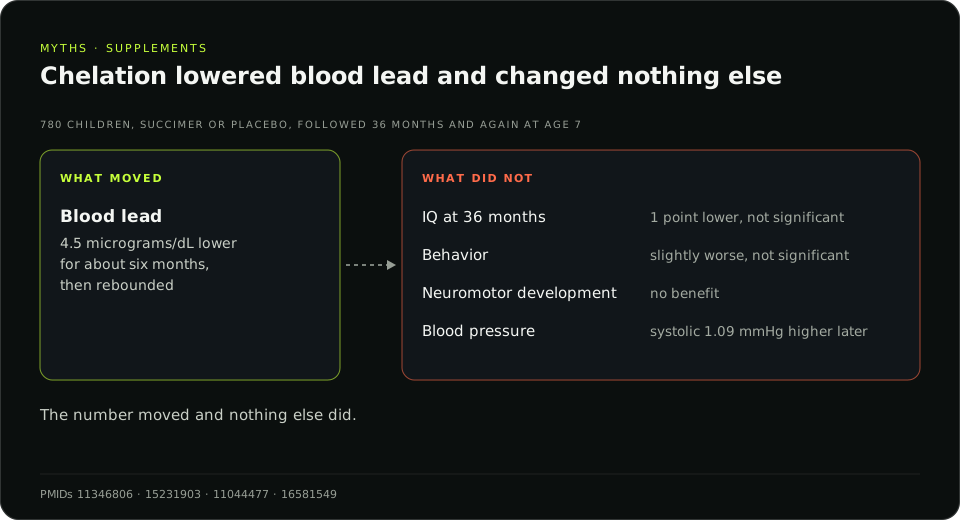
A four-city trial randomized 780 children aged 12 to 33 months, all with blood lead between 20 and 44 micrograms per deciliter, to up to three 26-day courses of oral succimer or to placebo, double blind. Every participant received residential lead hazard control before treatment and a daily multivitamin. Cognitive, behavioral, neuromotor and neuropsychological function were followed for 36 months, and the cohort was tested again at age seven. Blood pressure was analyzed separately over one to five years of follow-up. A companion analysis used samples from the same trial to ask whether the same drug lowered mercury at ordinary background exposures.
What moved in the trial, and what did not. Opens full size in a new tab../assets/images/diagrams/chelation.svg
Verdict
The number moved and nothing else did. Blood lead fell by a clear, replicatedThe same finding reproduced by a separate research group. A result seen once can be chance or bias; a replicated one is harder to explain away. margin, and across four separate outcome analyses of the same randomized cohort, covering cognition, behavior, neuromotor function and blood pressure, no benefit followed. One of those analyses found the fall was temporary and rebounded. The claim treats the falling level as the result. In the only large randomized test of that reasoning, the falling level was the whole of the result.
The trials separated on a different outcome than the one the belief is about.
The common rebuttal was also tested
The usual objection is that this was lead in poisoned children rather than a general detox in ordinary adults. The mercury analysis is the closest available answer, because it asked whether the same drug lowers a metal at background exposures rather than at toxic ones, and found limited efficacy attributable to preventing an age-related rise. It is worth noting what the objection concedes: if trials in the population with the highest measurable burden, using a prescription chelator, found no outcome benefit, the case does not become easier at lower burdens with weaker agents.
What these trials do not settle
None of this speaks to acute high-level poisoning, where chelation is established medical treatment and is not in question here. These trials tested one prescription agent, at one dose range, in one age group, at blood lead levels of 20 to 44 micrograms per deciliter. No retail oral binder, clay, zeolite, cilantro or algae preparation was tested in any of them, and no trial of that kind reporting a health outcome was located. A randomized trial of a consumer detox protocol reporting a clinical outcome, rather than a urine or blood level, would change this entry.
October 2026Mechanism only
No human trial has measured whether sulforaphane prevents cancer or extends life
A standing premise of broccoli sprout and sulforaphane supplement marketing; no single source
The claim
That sulforaphane, the compound formed from glucoraphanin in broccoli seeds and sprouts, protects against cancer, detoxifies the body, protects the brain and slows aging, because it switches on the body's Nrf2 defense pathway.
What was tested
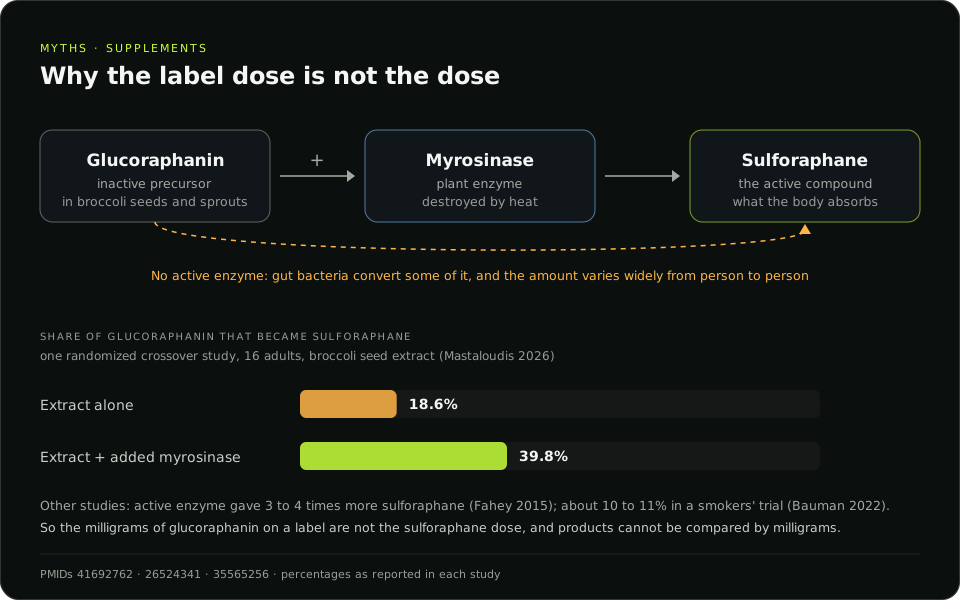
The Nrf2 mechanism is real and well characterized in the laboratory. In people, sulforaphane products have been tested on narrower questions: whether they raise the body's excretion of airborne pollutants, whether they help negative symptoms or cognition in schizophrenia when added to antipsychotic medication, whether they change behavior scores in autism, whether they slow a rising PSA after prostate cancer surgery, and whether a related precursor product slows memory decline. How much sulforaphane a product delivers depends on whether it supplies active myrosinase, the plant enzyme that converts glucoraphanin. EBL's own sulforaphane record covers a separate question, glucose control in type 2 diabetes, and is unchanged by this entry.
Why a label's glucoraphanin milligrams are not the sulforaphane dose. Figures from the sources listed below. Opens full size in a new tab../assets/images/myths/sulforaphane.svg
Verdict
The mechanism is real and the human trials are real, but they answer different questions from the one the claim asks. Sulforaphane products raise the excretion of some airborne pollutants, which measures detoxification chemistry, not disease. In schizophrenia the positive results come from two reports carrying one trial registration, the independent trials were null, and pooled, the benefit did not hold to the end of follow-up. In autism the trials disagree on which raters saw a change. The one cancer trial missed its primary endpoint. No trial has measured cancer incidence, cardiovascular events, dementia or lifespan.
A real mechanism with no human outcome evidence behind it.
The common rebuttal was also tested
The usual rebuttal is that sulforaphane is no mechanism-only supplement because it has positive randomized trials. That is true, and they are listed above. Two of the positive psychiatric reports share one registration and are counted as two studies in a meta-analysis, and co-authors on several of these trials are affiliated with, or advise, companies that make or supply broccoli seed extract. The positive trials exist; they do not reach the outcomes the claim is about.
What these trials do not settle
A randomized trial with cancer incidence, cardiovascular events or cognitive decline as its primary outcome would change this entry. So would an independent replication of the negative-symptom effect in schizophrenia, registered separately and holding to the end of follow-up. Products differ in whether they supply active myrosinase and in how much sulforaphane they deliver, so a result from one product does not transfer to another.
October 2026True but narrow
Creatine helped memory in some trials, mostly in older adults; it has not been shown to sharpen thinking overall
Widely repeated in fitness, nootropic and longevity media; no single source
The claim
That creatine, long taken for muscle, is also a brain supplement that sharpens thinking, focus and mental performance for anyone who takes it.
What was tested
Creatine and thinking have been studied in small randomized trials, most lasting days to a few months, in healthy people and in some patient groups. Four reviews have pooled them since 2018, and the European Food Safety Authority assessed the same body of trials in 2024 when a creatine manufacturer applied for a health claim on cognitive function.
PMID 39070254Systematic review and meta-analysis of randomized trials
16 trials, 492 adults aged about 21 to 76, healthy and with disease. Memory improved (SMD 0.31, 95% CI 0.18 to 0.44), as did attention time and processing speed. Overall cognitive function and executive function did not. The authors rated the certainty of evidence moderate for memory and low for every other domain. A corrigendum to this paper was published in 2025 (PMIDPubMed ID: the permanent number the US National Library of Medicine gives a published paper. Each one links to that paper's record on PubMed. 40034739).
Correction notice to the 2024 meta-analysis above, published in 2025.
PMID 35984306Systematic review and meta-analysis of randomized trials
10 trials in healthy people, 8 pooled. Memory improved overall (SMD 0.29), with high heterogeneityHow much the results of the pooled trials differ from each other. High heterogeneity makes a combined estimate less reliable.. By age group, the effect was in adults aged 66 to 76 (SMD 0.88) and absent in those aged 11 to 31 (SMD 0.03, 95% CI -0.14 to 0.20).
6 trials, 281 healthy people. Short-term memory and reasoning may improve; results for long-term memory, attention, executive function, reaction time and mental fatigue conflicted. Performance stayed unchanged in young people.
Creatine supplementation raises brain creatine content, to a limited extent, but the effects on cognition were equivocal. The authors call for trials that measure brain creatine and use better dosing regimens.
Assessed 23 human intervention studies for a claimed effect on cognitive function. A working-memory effect seen at 20 g a day for 5 to 7 days did not appear at 2.2 to 14 g a day or with 5 g a day for 6 weeks; a response-inhibition finding was isolated among 10 studies in healthy people; three studies in patients did not support an effect. Conclusion: a cause-and-effect relationship has not been established.
Verdict
Something is there, and it is narrow. Pooled trials find a small improvement in memory, carried mostly by older adults, while younger healthy people show essentially none. Overall thinking ability and executive function did not improve, the certainty for everything except memory is low, and Europe's food safety regulator found no established cause-and-effect relationship. The claim takes a modest memory signal in older adults and applies it to everyone's focus and mental performance.
It holds in the population studied and is applied well beyond it.
The common rebuttal was also tested
The usual defense is the mechanism: the brain is energy hungry and creatine supplies energy. Supplements do raise brain creatine, but only a little, and the trials that would show the mechanism turning into better thinking have not done so consistently. The European assessment also found that the clearest short-term memory effect came at 20 g a day, about four times the usual daily amount, and did not appear at ordinary doses.
What these trials do not settle
A trial of several months in healthy adults, at an ordinary daily dose, with a pre-registered cognitive outcome and brain creatine measured, that found a clear benefit beyond memory would change this entry. So would a trial showing that creatine slows cognitive decline in older adults over years.
October 2026Reversed by trials
Vitamin D did not prevent cancer or heart disease in three large trials
A standing premise of supplement marketing and general health media; no single source
The claim
That taking vitamin D protects against cancer, heart attacks and early death, because people with low vitamin D levels get these diseases more often.
What was tested
The belief began with observationalResearch that watches what people already do rather than assigning a treatment. It can show that two things travel together, not that one causes the other. studies, in which people with low blood vitamin D had more cancer and heart disease. Three large randomized trials then tested supplements directly in older adults not selected for deficiency: VITAL in the United States (daily dosing), D-Health in Australia and ViDA in New Zealand (monthly dosing). Each ran for about three to six years and counted diagnoses and deaths.
25,871 adults, 2,000 IU of vitamin D3 a day or placebo, median 5.3 years. Invasive cancer: hazard ratioHow often an event happened in the treated group compared with the control group over the same period. A ratio of 0.80 means 20 percent fewer events. 0.96 (0.88 to 1.06). Major cardiovascular events: 0.97 (0.85 to 1.12). Death from any cause: 0.99 (0.87 to 1.12). Death from cancer, a secondary outcome: 0.83 (0.67 to 1.02), an interval that crosses no effect.
21,315 Australians aged 60 to 84, 60,000 IU a month or placebo for 5 years. All-cause mortality: hazard ratio 1.04 (0.93 to 1.18). Cancer mortality: 1.15 (0.96 to 1.39). Cardiovascular mortality: 0.96 (0.72 to 1.28). The authors note that point estimates were consistent with more cancer deaths, not fewer.
PMID 40096917Analysis of a randomized controlled trial (D-Health)
Cancer incidence from linked state cancer registries in 21,308 participants: 1,336 diagnosed on vitamin D and 1,304 on placebo, hazard ratio 1.02 (0.95 to 1.10). No difference for the individual cancers analyzed.
PMID 37380191Analysis of a randomized controlled trial (D-Health)
Major cardiovascular events in 21,302 participants: 6.0 percent on vitamin D and 6.6 percent on placebo, hazard ratio 0.91 (0.81 to 1.01). The authors describe the absolute difference as small and the interval as consistent with no effect.
5,108 adults aged 50 to 84 in New Zealand, a 200,000 IU starting dose then 100,000 IU a month, median 3.3 years. Cardiovascular disease: 11.8 percent on vitamin D and 11.5 percent on placebo, hazard ratio 1.02 (0.87 to 1.20). Results were similar in the quarter who started out deficient.
PMID 30027269Post hoc analysis of a randomized controlled trial (ViDA)
Cancer in the same 5,108 participants: 6.5 percent on vitamin D and 6.4 percent on placebo, hazard ratio 1.01 (0.81 to 1.25).
Verdict
The association is real: people with low vitamin D do get these diseases more often. When supplements were tested against placebo in more than 50,000 older adults across three countries, cancer diagnoses, cardiovascular events and deaths did not fall, whether vitamin D was given daily or monthly. The trials point the other way from the claim. Low vitamin D appears to travel with poor health rather than cause it, at least for these outcomes in people not selected for deficiency.
The trials point the other way.
The common rebuttal was also tested
The usual rebuttal is that vitamin D lowers cancer deaths even if it does not prevent cancer. VITAL's cancer-death result leaned that way (0.83) with an interval that included no effect, and it was a secondary outcome. D-Health, the next large trial, leaned the opposite way (1.15), also with an interval that included no effect. Neither settles it. A second rebuttal is that most participants were not deficient: ViDA reported the deficient quarter separately, and the result for heart disease was the same.
What these trials do not settle
A large trial in people selected because their vitamin D was low, measuring cancer, cardiovascular events or death as the primary outcome, that found fewer of them on vitamin D would change this entry. So would a trial designed to test cancer death as its main outcome.
October 2026Reversed by trials
Collagen helped skin in company-funded trials; in independent and high-quality trials it did not
A standing premise of collagen supplement marketing and beauty media; no single source
The claim
That collagen powders and drinks reverse skin aging: smoother wrinkles, firmer and more hydrated skin within a few weeks.
What was tested
Oral collagen for skin has been tested in more than 20 small randomized trials, mostly in women, mostly for 8 to 12 weeks, with skin hydration, elasticity and wrinkle depth measured by instruments. Three meta-analyses have pooled them. The 2025 analysis was the first to split the trials by who paid for them and by their quality.
PMID 33742704Systematic review and meta-analysis of randomized trials
19 double-blindNeither the participants nor the people assessing them know who received the real treatment until the trial ends. trials, 1,125 participants aged 20 to 70, 95 percent women. Hydrolyzed collagen improved hydration, elasticity and wrinkles against placebo. The authors conclude 90 days of use reduces skin aging.
PMID 37432180Systematic review and meta-analysis of randomized trials
26 trials, 1,721 participants. Hydration and elasticity improved against placebo. The authors identified several biases in the included trials and call for larger trials to confirm the findings.
PMID 40324552Systematic review and meta-analysis of randomized trials
23 trials, 1,474 participants. All trials pooled: hydration, elasticity and wrinkles improved. Trials not funded by companies: no effect on any of the three. Company-funded trials: significant effects. High-quality trials: no significant effect in any category; low-quality trials: improved elasticity. The authors conclude there is no clinical evidence to support collagen supplements to prevent or treat skin aging.
Verdict
Pooled together, the trials show better skin hydration, elasticity and wrinkles, which is where the claim comes from. Once the trials are separated by funding and by quality, the picture reverses: the benefit sits in company-funded and lower-quality trials, and the trials without company money, and the high-quality ones, show no effect. The trials least open to bias point the other way from the claim.
The trials point the other way.
The common rebuttal was also tested
The usual rebuttal is that company funding does not by itself make a trial wrong, which is true, and that the earlier meta-analyses were positive. They were, but they did not separate trials by funder or by quality, and one of them noted several biases in the included trials. When a benefit appears only where the seller pays and disappears where an outside group runs the trial, the pooled result cannot carry the claim.
What these trials do not settle
An independently funded, pre-registered trial of several months, large enough to detect a modest difference, that found improved skin elasticity or wrinkles on collagen against placebo would change this entry. A replication by a second independent group would change it further.
October 2026True but narrow
Gene tests guided medication choices in a large trial; for diet and supplements, adding genes added nothing
A standing premise of direct-to-consumer nutrigenomic test marketing; no single source
The claim
That a cheek-swab gene test can tell you in advance which supplements and diet changes your body will respond to, so a supplement that did not work for you was simply the wrong one for your genes.
What was tested
Gene-guided choice has been tested in two different settings. For medications, a large randomized implementation study tested a 12-gene panel used to guide prescribing. For diet, the largest randomized trial of personalized nutrition compared advice built on what people ate with advice that also used their genotype.
PMID 36739136Open-labelEveryone in the trial knows which treatment they are receiving, so expectations can shape the results, especially for symptoms people report themselves., multicenter, cluster-randomized crossover implementation study
6,944 patients in seven European countries. Prescribing guided by a 12-gene panel was followed by fewer clinically relevant adverse drug reactions within 12 weeks than standard care: 21.5 percent against 28.6 percent (odds ratio 0.70). The trial measured side effects, not whether the drugs worked better.
Adults in seven European countries were randomized to standard dietary advice or to personalized advice based on diet alone, on diet plus blood and body measures, or on diet plus those measures plus five diet-related genetic variants, for 6 months; 1,269 completed. Personalized advice improved diet more than standard advice. Adding the measures or the genotype did not improve it further.
Verdict
Gene-guided choice holds where it was tested against an outcome: medications, where a 12-gene panel was followed by fewer adverse drug reactions. For diet and supplements, the one large randomized trial found that genetic results added nothing beyond advice based on what people already ate. No randomized trial has shown that choosing a supplement by genotype improves a health outcome.
It holds in the population studied and is applied well beyond it.
The common rebuttal was also tested
The usual rebuttal is that people respond differently to the same supplement, which is true. A difference in response is not the same as a test that predicts it, and the trial that added genotype to dietary advice found no gain from it. A supplement can still work for one person when no trial has shown who responds.
What these trials do not settle
A randomized trial in which people given supplements chosen by their genotype had better health outcomes than people given the same supplements without genotyping would change this entry. A replication by an independent group would change it further.
Sleep and light
October 2026Never tested
Bright light treats depression in trials; the 30-minutes-after-waking rule was never tested
Widely repeated in podcast and social-media sleep advice; no single source
The claim
That sunlight must reach the eyes within 30 minutes of waking to set the body clock, and that doing so improves sleep, mood and energy for everyone.
What was tested
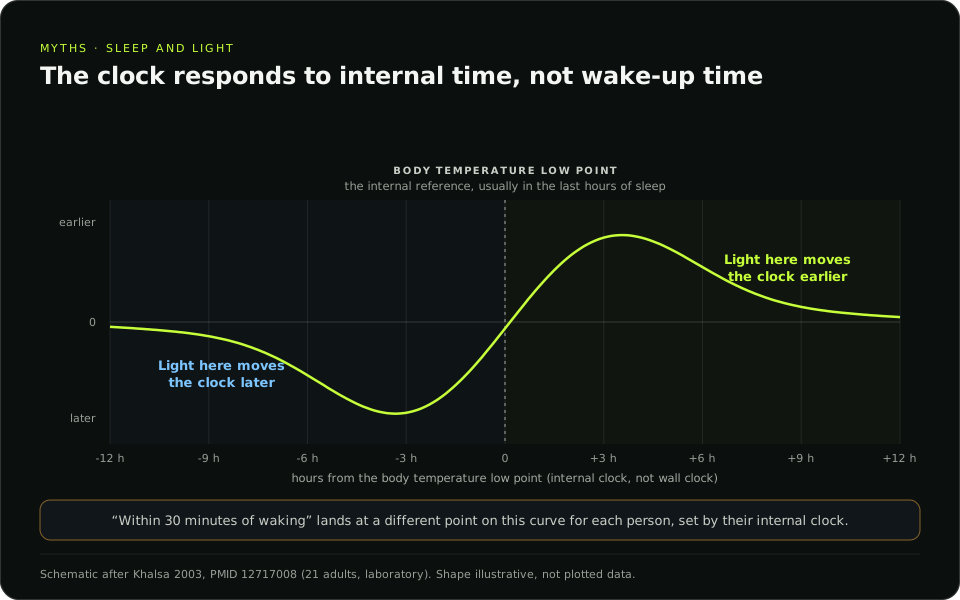
Light does reset the human clock, and that part has been measured precisely in the laboratory. Light treatment has also been tested in randomized trials, nearly all of them in depression and nearly all using a 10,000 lux light box for about 30 minutes a day. What has not been tested is the rule itself: no randomized trial located for this entry assigned healthy people to outdoor light within a fixed window after waking and measured sleep, mood or health. Two reviews also reported on hypomania, the main safety question for bright light.
Schematic after the 2003 laboratory study (PMID 12717008). The shape is illustrative, not plotted data. Opens full size in a new tab../assets/images/myths/morning-light.svg
Verdict
Two true things are joined into a rule that neither supports. Light does move the clock, and bright light does treat depression in randomized trials, seasonal and non-seasonal. But the clock responds to light according to each person's internal timing, not to the minutes since waking, and the large trial built to compare morning with evening light found no difference on its main analysis. The treatment trials gave about 30 minutes of a 10,000 lux box to people with depression. None tested outdoor light within a fixed window after waking in healthy people, which is what the rule claims.
Widely repeated, never put to a trial.
The common rebuttal was also tested
The usual defense of the rule is that morning light simply works better than light at other times. That was tested directly in 158 patients: morning and evening light performed the same on the main analysis, with morning ahead only on a stricter remission cut-off, and an older review found morning light did better than control in non-seasonal depression. Morning timing has the better case of the two, but a modest one, and it was measured in depression, not in healthy sleepers.
What these trials do not settle
A randomized trial in healthy adults that assigned outdoor light at a fixed interval after waking, against later light or none, with sleep timing, sleep quality or mood as the measured outcome, would change this entry. On safety, one review found more hypomania on bright light and a later review in bipolar depression found no difference in mood switches; that question is open, and these trials do not settle it.
Longevity
August 2026Reversed by trials
The trials that tested antioxidant supplements did not find longer life
A standing premise of antioxidant supplement marketing and of popular longevity writing; no single source
The claim
That oxidative damage drives aging, and that taking antioxidant supplements therefore slows it and extends life. The reasoning runs from a real mechanism to a supplement bottle without stopping at a trial.
What was tested
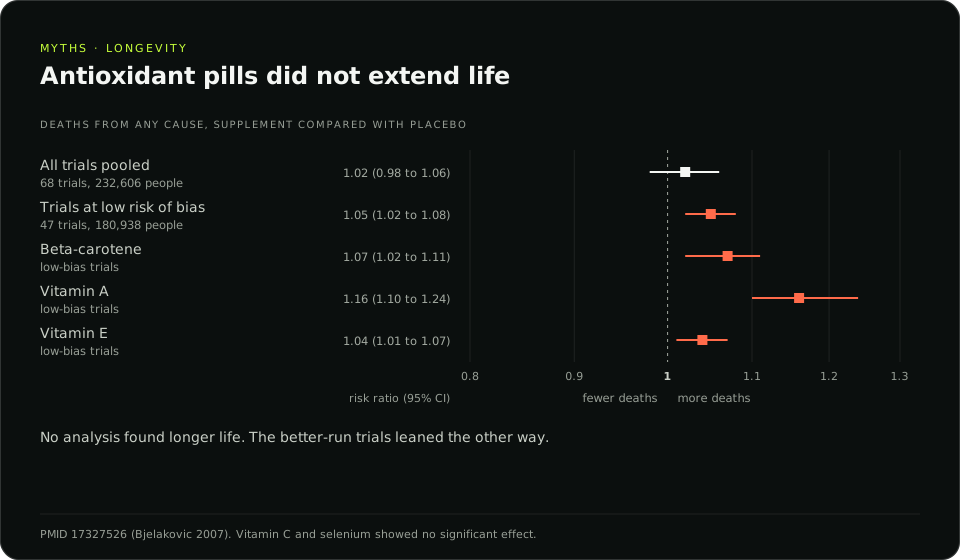
Two systematic reviews pooled the randomized evidence on beta-carotene, vitamin A, vitamin C, vitamin E and selenium against placebo or no intervention, in both primary and secondary prevention, with all-cause mortality as the outcome. The larger covered 78 trials and 296,707 participants, mean age 63, 46 percent women, with supplementation lasting from 28 days to 12 years and a median of two years. Separately, three large randomized prevention trials tested single agents at scale against hard cancer endpoints in tens of thousands of people.
Deaths across the antioxidant trials, all pooled and by agent. Opens full size in a new tab../assets/images/diagrams/antioxidants.svg
Verdict
Nearly 300,000 people were randomized to answer this question and no life extension appeared in any analysis of them. Pooled across every trial the effect on mortality is null, and in the subsets where risk of bias was lowest it points the wrong way. The three largest single-agent prevention trials each ended with more disease in the supplemented group, not less. A mechanism that is real in a cell did not survive the step to a bottle and a person.
The trials point the other way.
The common rebuttal was also tested
The usual reply is that the wrong doses or the wrong forms were used. That objection has to contend with the doses actually tested, which were the ones being sold and recommended at the time, and with the direction of the result. A dosing error would be expected to produce nothing. What several of these trials produced was harm, on their pre-specified primary endpoints, in populations chosen because they had the most to gain.
What these trials do not settle
Not every antioxidant behaved the same way. Vitamin C and selenium showed no significant mortality effect in either analysis, so the claim does not fail uniformly across the category. Nothing here concerns antioxidants eaten as food, which was never what was randomized. Two of the three single-agent trials enrolled smokers or asbestos-exposed workers, a population with a specific cancer risk, which limits what the lung cancer findings transfer to. The mortality increase also depends on how the trials are selected, and both reviews report a null result when every trial is included. A large low-bias randomized trial of a specific antioxidant reporting lower all-cause mortality would change this entry.
October 2026Never tested
Frequent sauna use tracks with longer life in Finnish men; no trial has tested whether it causes it
Widely repeated in longevity podcasts, wellness media and sauna marketing; no single source
The claim
That regular sauna use adds years of life, cutting the risk of heart disease, sudden cardiac death and dementia by half or more.
What was tested
The headline figures come from one Finnish cohort: about 2,300 middle-aged men in Eastern Finland, asked in the 1980s how often and how long they used a sauna, then followed for about 20 years. Randomized trials of sauna exist, but they are short and measure blood pressure, fitness and heart function, not how long people live.
PMID 25705824Prospective cohort studyAn observational study that follows a group of people over time and compares what happens to them.
2,315 Finnish men aged 42 to 60, followed for a median of 20.7 years. Compared with one session a week, 4 to 7 sessions a week was associated with lower sudden cardiac death (hazard ratio 0.37), and similar associations were found for fatal coronary disease, fatal cardiovascular disease and death from any cause. Longer sessions were associated with lower cardiac deaths but not with lower death from any cause.
The same 2,315 men. Compared with one session a week, 4 to 7 sessions a week was associated with less dementia (hazard ratio 0.34) and Alzheimer's disease (0.35).
47 inactive adults with at least one cardiovascular risk factor. Exercise plus a 15-minute sauna after each session improved fitness more, and lowered systolic blood pressure by 8.0 mmHg and total cholesterol more, than exercise alone.
16 studies of sauna on cardiovascular function. Right after a session, blood pressure fell by about 5 to 7 mmHg and heart rate rose. Over 2 to 4 weeks, ejection fraction, walking distance and blood vessel function improved, most in people with weak heart function.
31 inactive adults with overweight, average age 58, assigned to cycling, sitting in 40 C water to the chest, or no change, three times a week. Only cycling improved blood vessel function in the leg more than the control group. In the arm, both cycling and hot water raised vessel function from the start; cycling beat the control group, and hot water did not differ significantly from cycling. Neither changed blood pressure or arterial stiffness. This tested hot water, not a sauna.
Verdict
The sauna findings are real associations from a well-run cohort, and short trials show real changes in blood pressure and fitness. What has never been tested is the claim itself: no randomized trial has assigned people to regular sauna and counted heart attacks, dementia or deaths. In the cohort, men who used a sauna 4 to 7 times a week may have differed from once-a-week users in health, wealth and habits in ways no adjustment fully removes. The cohort was also men only, in one region of Finland, using a traditional hot sauna, not the infrared cabins most sold today.
Widely repeated, never put to a trial.
The common rebuttal was also tested
The usual defense is the dose response: more sessions, fewer deaths, which looks like cause and effect. A dose response strengthens an association but does not prove one, because the men well enough to sit in a hot sauna four or more times a week are a selected group. The short trials do show blood pressure falling by a few points; how much of a 63 percent drop in sudden cardiac death that could explain is the question no trial has answered. A 2026 head-to-head trial points the same way for heat in general: hot-water immersion did not match cycling for blood vessel function, and neither changed blood pressure.
What these trials do not settle
A randomized trial assigning adults to frequent sauna or usual habits for several years, with cardiovascular events, dementia or death as the outcome, would change this entry. Cohorts in women, outside Finland and with infrared sauna would show whether the association travels.
What this page does not do
It does not tell you whether to test, and it does not tell you what to do with a result. A population prevalence is not a statement about any individual, and NHANES does not diagnose anyone. The survey language is deliberately "at risk of deficiency" rather than "deficient", and that wording is preserved here.
Three nutrients are covered so far. The remainder are being sourced the same way, one threshold and one survey cycle at a time, and none will appear here until they are.