Separating what the longevity industry claims from what human randomized evidence actually supports. Each case takes one claim that circulates widely, names the study behind it, and sets the two side by side.
How to read these
A case names the claim, never the person, the publication or the brand that made it. That is deliberate. People revise their positions and claims keep circulating, so a case argues with the claim, which is checkable, rather than with someone's state of mind, which is not.
Every case links the identifier for the paper it discusses. You are meant to open it. If a case is wrong, the paper is how you would find out.
August 2026Source reversed
High-protein diets shorten lifespan
Longevity newsletter to a consumer list, July 2026
The claim as it circulates
That the research shows people eating high-protein diets die sooner, and that older adults trying to hold on to muscle should therefore eat less protein rather than more.
What the source actually says
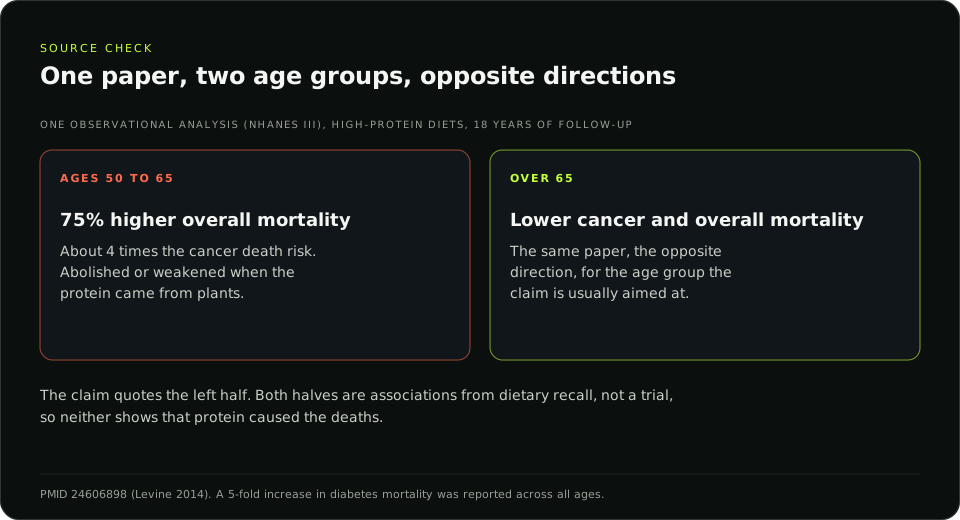
One observationalResearch that watches what people already do rather than assigning a treatment. It can show that two things travel together, not that one causes the other. analysis is doing all the work behind this claim, and its own abstract splits the result by age. In adults aged 50 to 65 a high-protein intake was associated with a 75% increase in all-cause mortality and roughly a fourfold increase in cancer death over eighteen years of follow-up. In adults over 65 the direction reverses: high protein intake was associated with REDUCED cancer and overall mortality. The associations were abolished or attenuated when the protein came from plants, and a fivefold increase in diabetes mortality was reported across all ages. The authors' own stated conclusion is low protein during middle age FOLLOWED BY moderate to high protein in older adults.
The two age groups in the cited paper, pointing in opposite directions. Opens full size in a new tab../assets/images/diagrams/protein-age-split.svg
Verdict
The claim reproduces the first half of a two-part finding and drops the half that contradicts it. Presented to an older readership, it inverts the source: for adults over 65 the cited analysis points the other way. The finding is also associational, drawn from dietary recall in a national survey rather than from any trial that assigned people to eat more or less protein, so it cannot establish that protein intake caused the deaths in either direction.
The cited paper reports the opposite in the population being addressed.
Also worth knowing
The paper carries a declared competing interest. Its senior author holds an equity interest in a company developing fasting-mimicking medical food. That disclosure is printed in the paper and is invisible to anyone who only hears the finding quoted onward.
What would change this
A randomized trial assigning older adults to different protein intakes and following hard endpointsAn outcome that matters directly to a person and is counted without judgment, such as death, heart attack, stroke or fracture.. No such trial exists. Until one does, protein intake in older adults sits on associational evidence pointing in both directions depending on age band and protein source.
August 2026Credential as citation
A researcher with 77 peer-reviewed papers says this, so it is settled
Health newsletter and social posts to a consumer list, August 2026
The claim as it circulates
A list of physiological claims about how women should train, eat and supplement, introduced by a count of the peer-reviewed papers its source has authored. The count is the only evidence offered. No claim in the list is attached to a paper, and the papers being counted are not the papers the claims come from: the credential is drawn from a body of published research and the claims are transcribed from a podcast appearance.
What the source actually says
Nothing, because nothing was cited. That is the defect. The reader is asked to accept a specific physiological claim on the strength of a publication count, and a publication count is not a finding. Where the individual claims can be checked against the literature, at least one runs the other way. One item asserted that creatine improves bone density in women. Three randomized trials have tested creatine on bone in postmenopausal women and a 2026 systematic reviewA review that searches for every study on a question using a method set in advance, then assesses them together. pooled them. The one positive result came from the smallest and shortest trial: 12 months, 47 randomized and 33 analyzed, reporting attenuated femoral neck bone mineral density loss. The two larger and longer trials, both running 2 years at 200 and 237 participants, found nothing on bone mineral density at any site. The pooled review found bone density unchanged overall.
PMID 42141930Systematic review and meta-analysisA study that pools the numbers from several trials into one combined estimate.
Seven randomized controlled trialsPeople are assigned to the treatment or a comparison by chance, so the groups differ only in what they received. It is the design that can show cause and effect., 608 participants, 12 to 104 weeks, mean age about 62. Lean mass favored creatine at a mean difference of 0.37 kg (95 percent CI 0.05 to 0.69), with a 95 percent prediction interval of -0.10 to 0.84 that crosses zero. Leg-press one-repetition maximum improved by 7.5 kg (2.2 to 12.8) across 3 trials and 111 participants. Benefit appeared where 5 g per day or more was combined with resistance training; trials at 3 g per day or less without resistance training showed no measurable effect. Bone density was unchanged overall, and the authors state that effects on bone density remain unclear.
237 postmenopausal women, mean age 59, randomized to creatine at 0.14 g/kg/day or placeboAn inactive substitute made to look like the real treatment, so participants cannot tell which one they received. alongside resistance training 3 days a week and walking 6 days a week for 2 years. No effect on bone mineral density at the femoral neck, total hip or lumbar spine. Section modulus and buckling ratio at the narrow femoral neck were maintained relative to placebo, which are bone geometry measures rather than density. No effect on one-repetition maximum for bench press or hack squat. Walking time over 80 m improved. Lean tissue mass increased in a subanalysis of valid completers.
200 postmenopausal women with osteopenia randomized to creatine at 3 g per day or placebo for 2 years. Areal bone mineral density fell over time at lumbar spine, femoral neck and total femur with no group interaction. Bone markers, microarchitecture, falls and fractures were unchanged. Lean mass and appendicular skeletal muscle mass rose over the trial with no additive effect of creatine. The authors state the result refutes the notion that creatine alone has osteogenic or anabolic properties in the long run.
47 postmenopausal women randomized and 33 analyzed at 12 months, creatine at 0.1 g/kg/day during supervised resistance training 3 days a week. Femoral neck bone mineral density loss was attenuated against placebo, -1.2 percent versus -3.9 percent, and femoral shaft subperiosteal width increased. Relative bench press strength rose more on creatine, 64 percent versus 34 percent. This is the positive bone result, and it is the smallest and shortest of the three trials.
Verdict
A publication count establishes that someone has done research. It does not establish that any particular sentence attributed to them is a finding from that research, and here the sentences and the papers have different origins. The structure invites a transfer the piece never earns: authority is sourced from a body of work, claims are sourced from a conversation, and the gap between them is filled by the reader. This is checkable in a way the claims themselves are not. Anyone can confirm that no claim in the list carries a citation, without needing to know any physiology. Where the claims can be checked, the bone density item does not survive the trials, and the pattern is the point rather than that single item: a reader given the count and no citations has no way to tell which items would survive and which would not.
A body of work establishes the authority; the claims that follow are not from it and carry no source.
Also worth knowing
EBL published a version of the same defect. This site's own creatine record carried one Grade A whose stated uses ran from muscle strength to cognitive function and brain energy reserve, with a single letter covering all of them, and those uses do not rest on the same evidence. It was found while writing this case. The record has been split so that each use carries the grade its own trials support, and the bone density use now carries the grade the trials actually produced, which is D.
What would change this
For the pattern: claims published with the specific paper each one rests on, so a reader can check any single item without accepting or rejecting the whole list. For the bone density item specifically: a randomized trial in postmenopausal women, powered for bone mineral density, at 5 g per day or more alongside resistance training, running long enough to measure bone change. The trials that exist have either used lower doses without resistance training or have been null at 2 years, and the pooled review states the bone question is unresolved rather than answered.
What this page does not do
It does not tell you whether to test, and it does not tell you what to do with a result. A population prevalence is not a statement about any individual, and NHANES does not diagnose anyone. The survey language is deliberately "at risk of deficiency" rather than "deficient", and that wording is preserved here.
Three nutrients are covered so far. The remainder are being sourced the same way, one threshold and one survey cycle at a time, and none will appear here until they are.