Basal metabolic rate The energy the body burns at complete rest just to stay alive, measured lying still after an overnight fast. It is the largest share of daily calories for most adults. (BMR Basal metabolic rate: the energy the body burns at complete rest just to stay alive, counted in calories per day.)
The energy it takes just to stay alive.
Your basal metabolic rate is the energy your body burns while you lie completely still: keeping your heart beating, your lungs breathing, your brain running and your body warm. For most adults it is the largest share of the calories they use in a day, larger than exercise. It is counted in calories per day, it depends mostly on how much lean tissue you carry, and it drifts down slowly in later life.
Three numbers that get mixed up
BMR, RMR and total daily energy.
Researchers measure basal metabolic rate under strict conditions: the person is awake, lying down, at a comfortable room temperature, after a night of sleep and an overnight fast of about 12 hours, with no exercise beforehand. Those conditions remove the energy cost of digesting food, moving around and keeping warm or cool, which leaves only the cost of running the body.
- BMR, basal metabolic rate
- Energy used at complete rest, measured under the strict conditions above.
- RMR, resting metabolic rate The energy the body burns at rest, measured under looser conditions than the basal rate, such as a shorter fast. It usually runs slightly higher than the basal metabolic rate.
- Also called resting energy expenditure. The same idea measured under looser conditions, such as a shorter fast. It usually runs slightly higher than BMR, and research papers, clinics and consumer devices often use the two terms interchangeably.
- Total daily energy expenditure
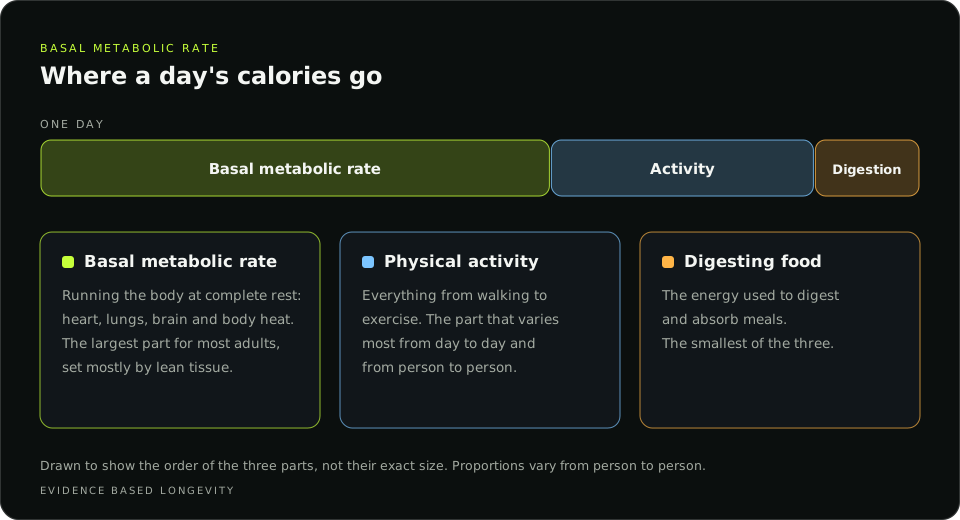
- Everything burned in a day: the basal rate, plus the energy used to digest food, plus all physical activity. For most adults the basal rate is the largest of the three parts.
What sets it
Mostly lean tissue, then everything else.
Lean mass. Lean tissue, also called fat-free mass, is the strongest single predictor. In the 1990 study of 498 healthy adults that produced the most widely used estimating equation, fat-free mass alone explained about 64 percent of the differences in resting energy use between people (PMID PubMed ID: the permanent number the US National Library of Medicine gives a published paper. Each one links to that paper's record on PubMed. 2305711).
Organs. The liver, brain, heart and kidneys weigh little but burn a large share of resting energy. Muscle burns less per pound, but most people carry far more of it.
Body size and sex. Larger bodies use more energy. Men average a higher basal rate than women, mostly because they carry more lean mass.
Hormones and health. Thyroid hormone is a major regulator: an overactive thyroid raises the basal rate and an underactive one lowers it. Fever, illness and some medications change it as well.
Age. Covered in its own section below.
Measured or estimated
Most BMR numbers are not measurements.
A basal rate is measured by indirect calorimetry. A hood or mask collects the air a person breathes out, and the oxygen used and carbon dioxide produced are converted into calories. This is done in research laboratories and some clinics.
Online calculators, fitness trackers and smart scales do not measure it. They estimate it from weight, height, age and sex with an equation. The two best known:
Mifflin-St Jeor (1990). Built from indirect calorimetry in 498 healthy adults aged 19 to 78. Men: 10 times weight in kilograms, plus 6.25 times height in centimeters, minus 5 times age in years, plus 5. Women: the same, minus 161 instead of plus 5. In the same study the older Harris-Benedict equations overestimated measured resting energy use by about 5 percent (PMID 2305711).
Harris-Benedict. The original equation, more than a century old and still built into many calculators.
A systematic review A review that searches for every study on a question using a method set in advance, then assesses them together. comparing the common equations found that Mifflin-St Jeor came within 10 percent of the measured value in more people, lean and obese, than the others, with the narrowest range of error (PMID 15883556). Even the best equation can miss an individual by more than that, so a calculated number is an estimate, not a measurement.
Age
Steady through midlife, slower after 60.
The largest study of human energy use pooled measurements from 6,421 people aged 8 days to 95 years in 29 countries, with the basal rate measured in 2,008 of them (PMID 34385400). After adjusting for body size and lean mass, energy use was highest in the first year of life, fell through childhood to adult levels around age 20, held steady from about 20 to 60, including during pregnancy, and declined after about 60 by roughly 0.7 percent a year. The basal rate followed the same pattern.
So the common belief that metabolism slows sharply in midlife was not supported. Much of the lower basal rate in older adults reflects lost lean mass, and the same study found an additional slowing in the tissues themselves after 60.
After weight loss
A smaller body burns less, and sometimes less again.
When people lose weight, the basal rate falls because there is less body to run. Some studies report that it falls further than the weight loss alone predicts, a pattern called metabolic adaptation or adaptive thermogenesis.
The best-known example followed contestants from the television program The Biggest Loser six years after the competition and found their resting metabolic rate still well below what their body size predicted (PMID 27136388). A later reanalysis of the same data argued that the persistent gap is better explained by the body compensating for high levels of physical activity than by a permanently damaged metabolism (PMID 34816627). How large and how lasting metabolic adaptation is remains debated.
BMR and longevity
A slower metabolism, a longer life? Not shown in people.
An old idea in aging research, the rate of living theory, holds that a body burning energy more slowly ages more slowly. Calorie restriction lowers energy use in animals and extends lifespan in many of them, which is why the question keeps coming back.
The largest randomized trial in people, CALERIE, assigned healthy non-obese adults to 25 percent calorie restriction or their usual diet for two years. Its primary endpoints The one outcome a trial names in advance as its main test. Results on other outcomes carry less weight., resting metabolic rate adjusted for weight and core temperature, did not differ durably between the groups (PMID 26187233). The full EBL record, with the later analyses, is caloric restriction.
Genetic evidence points the same way as the old theory, weakly. A Mendelian randomization study in UK Biobank found that a genetically higher basal rate was linked to shorter parental lifespan: about 0.46 years of life lost per unit for fathers and 1.36 years for mothers, a stronger link in women than men (PMID 37173352). A check against survival to very old age found no significant link, and the authors concluded only that a higher basal rate might reduce lifespan. A genetic difference carried from birth is not the same as changing the basal rate later in life.
No human trial has shown that deliberately lowering or raising the basal rate changes how long a person lives.
Cautions
What a BMR number cannot tell you.
A basal rate from a calculator, tracker or smart scale is an estimate and can be off by 10 percent or more for any one person.
An unexplained change in weight, energy, or tolerance of heat or cold can reflect thyroid disease or another medical condition, which is a clinician's evaluation. An estimated basal rate cannot detect it.
Eating well below the basal rate for long periods costs lean tissue as well as fat. It carries particular risk in pregnancy, in children, in older adults already losing muscle, and in anyone with a history of an eating disorder.
The basal rate is explained here so the rest of the site makes sense. It is not graded and it is not a target.
Go further
From metabolism to the records.
Your basal rate is mostly your lean tissue. A calculator only estimates it.
Educational use only, not medical advice.