No. 357 · October 2026 · new-record
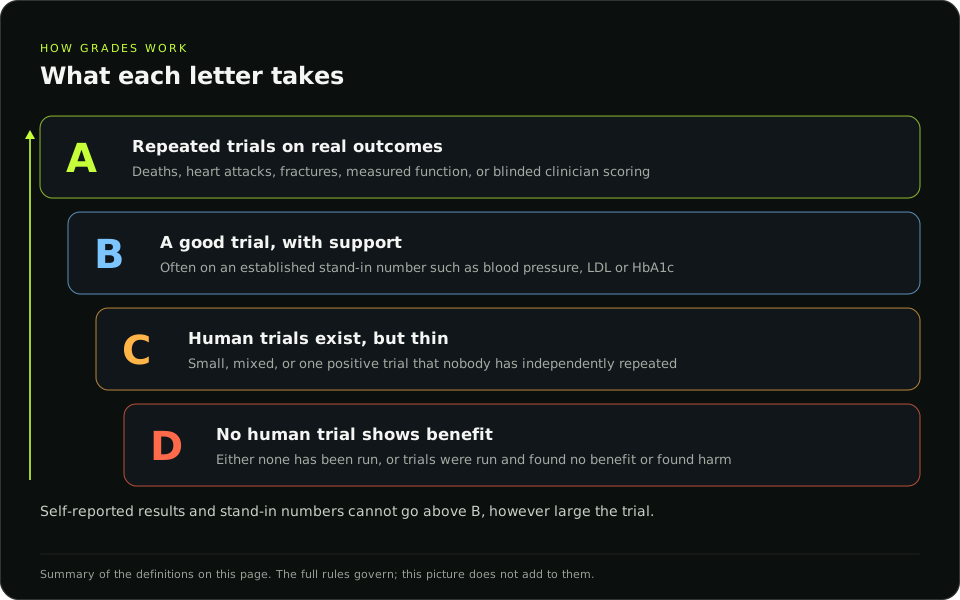
The plant-based diet page carried a Grade B with no record behind it and no citation. It now has a graded record. A meta-analysis of 30 randomized trials found vegetarian and vegan diets lowered LDL cholesterol by 0.30 mmol/L against omnivorous diets (Koch et al., Eur Heart J, 2023; PMID PubMed ID: the permanent number the US National Library of Medicine gives a published paper. Each one links to that paper's record on PubMed. 37226630), and a meta-analysis of 7 trials found HbA1c 0.40 percentage points lower in type 2 diabetes (Guest et al., Adv Nutr, 2024; PMID 39415400): both Grade B, on established surrogates. Heart attacks, strokes and mortality are Grade D: no randomized trial has tested the diet on its own against them, and the Cochrane review found none of its trials reported a cardiovascular event (Rees et al., Cochrane Database Syst Rev, 2021; PMID 33629376). Against other healthy diets, the LDL difference was small or absent.
No. 356 · October 2026 · correction
The nutrition page's meal timing entry had no citation. It now cites Gu et al. (J Clin Endocrinol Metab, 2020; PMID 32525525), a randomized crossover A trial design in which each participant receives both the treatment and the comparison, one after the other, and serves as their own control. trial in 20 healthy adults in which a 10 p.m. dinner raised overnight glucose compared with a 6 p.m. dinner, and sleep architecture did not differ. One small trial of one meal carries no letter.
No. 355 · October 2026 · correction
The nutrition page's liquid sugar entry had no citation. It now cites Maersk et al. (Am J Clin Nutr, 2012; PMID 22205311), a 6-month randomized trial in 47 overweight adults in which a liter a day of sugar-sweetened cola raised liver and visceral fat compared with milk, diet cola or water. One small trial carries no letter.
No. 354 · October 2026 · added
AREDS (Age-Related Eye Disease Study Research Group, Arch Ophthalmol, 2001; PMID 11594942) found zinc 80 mg with copper, combined with antioxidants, slowed progression to advanced macular degeneration in 3,640 adults with signs of the disease; zinc alone reached significance only in the higher-risk group. One trial, not independently repeated against placebo, is C. The record's top letter does not change.
No. 353 · October 2026 · added
VITAL-DEP (Okereke et al., JAMA, 2020; PMID 32749491) randomized 18,353 adults aged 50 and over to 2,000 IU a day or placebo for a median 5.3 years, with depression as a primary endpoint The one outcome a trial names in advance as its main test. Results on other outcomes carry less weight., and found no difference in depression or mood scores. One large null trial on the endpoint it was built for is Route 2, as on other single-trial rows, so this use enters at D. The record's top letter does not change.
No. 352 · October 2026 · correction
The nutrition page's polyphenol entry had no citation. It now cites COSMOS (Sesso et al., Am J Clin Nutr, 2022; PMID 35294962): 21,442 older adults, 500 mg of cocoa flavanols a day for a median 3.6 years, with total cardiovascular events not significantly lower and cardiovascular deaths lower as a secondary outcome. One trial that missed its primary endpoint carries no letter.
No. 351 · October 2026 · correction
The nutrition page's caffeine entry had no citation. It now cites Drake et al. (J Clin Sleep Med, 2013; PMID 24235903), a randomized crossover trial in 12 healthy adults in which 400 mg of caffeine taken even 6 hours before bed shortened measured sleep by more than an hour. One small trial of one dose carries no letter.
No. 350 · October 2026 · correction
Gene-test panels sold to choose diet changes and supplements now have a record. The largest randomized trial of the idea, Food4Me (Celis-Morales et al., Int J Epidemiol, 2017; PMID 27524815), gave adults in seven European countries personalized nutrition advice with and without their genotype; the genotype added nothing beyond advice based on diet alone. D on Route 2. Gene testing to guide medication choice is a different question and is not graded on this record.
No. 349 · October 2026 · added
A post hoc analysis of 777 adults aged 70 and older in the DO-HEALTH trial (Bischoff-Ferrari et al., Nat Aging, 2025; PMID 39900648) found 1 g/day of omega-3 slowed three of four DNA methylation clocks by about 3 to 4 months over 3 years. A methylation clock is not an established stand-in for a clinical outcome and the finding has not been repeated, so the row enters at C. The record's top letter does not change.
No. 348 · October 2026 · new-record
Meta-analyses of randomized trials, 28 trials (Whitehead et al., Am J Clin Nutr, 2014; PMID 25411276), 58 trials (Ho et al., Br J Nutr, 2016; PMID 27724985) and 13 trials in adults with raised cholesterol (Yu et al., Nutrients, 2022; PMID 35631184), find 3 g/day or more of oat beta-glucan lowers LDL cholesterol, and a randomized trial found the effect depends on molecular weight (Wolever et al., Am J Clin Nutr, 2010; PMID 20660224). LDL is a surrogate, so B is the ceiling. The high-cholesterol condition page previously listed oats under a soluble-fiber row whose evidence was psyllium only; oats now have their own row.
No. 347 · October 2026 · added
NOPARK (Brakedal et al., JAMA, 2026; PMID 42848371), a phase 3 randomized trial of 410 people with early Parkinson disease, found that those on nicotinamide riboside 1,000 mg/day for 52 weeks did worse than placebo on the primary rating score and on non-motor symptoms. This use enters at D with the TESTED, HARM FOUND badge. The record's top letter does not change.
No. 346 · October 2026 · added
Two large randomized trials of the standardized extract, GEM (DeKosky et al., JAMA, 2008; PMID 19017911) in 3,069 adults aged 75 and over and GuidAge (Vellas et al., Lancet Neurol, 2012; PMID 22959217) in 2,854 adults with memory complaints, did not prevent dementia or Alzheimer's disease. Prevention now has its own row at D, tested and no benefit. The rows on symptoms in people who already have dementia, and the record's top letter, do not change.
No. 345 · October 2026 · added
HOPE-2 (Lonn et al., N Engl J Med, 2006; PMID 16531613) and NORVIT (Bønaa et al., N Engl J Med, 2006; PMID 16531614) lowered homocysteine An amino acid in the blood that rises when vitamin B12, folate or B6 are low. without lowering heart attacks or cardiovascular deaths, and a Cochrane review of 15 trials (Martí-Carvajal et al., Cochrane Database Syst Rev, 2017; PMID 28816346) found no effect on heart attacks or deaths. This use enters at D, tested and no benefit. The separate first-stroke row and the record's top letter do not change.
No. 344 · October 2026 · added
The record graded cancer prevention only. HOPE (Yusuf et al., N Engl J Med, 2000; PMID 10639540), the Physicians' Health Study II (Sesso et al., JAMA, 2008; PMID 18997197) and the Women's Health Study (Lee et al., JAMA, 2005; PMID 15998891), three large randomized trials, did not lower major cardiovascular events, so heart protection now has its own row at D, tested and no benefit. The record's top letter does not change.
No. 343 · October 2026 · added
The completeness check found two endpoints the record did not grade. All-cause mortality: D-Health (Neale et al., Lancet Diabetes Endocrinol, 2022; PMID 35026158), 21,315 older Australians, found no reduction, and a pooled analysis of 52 trials (Zhang et al., BMJ, 2019; PMID 31405892) agrees, so this use enters at D, tested and no benefit. Progression from prediabetes to diabetes: D2d (Pittas et al., N Engl J Med, 2019; PMID 31173679), 2,423 adults, was not significant, while a three-trial pooled analysis by the same group (Pittas et al., Ann Intern Med, 2023; PMID 36745886), which includes a prescription vitamin D analog, was positive. Results that disagree are C under the written definition. The record's top letter does not change.
No. 342 · October 2026 · correction
A completeness check against the large vitamin D trials found two the record did not cite. ViDA (Scragg et al., JAMA Cardiol, 2017; PMID 28384800), 5,110 adults given monthly high doses, found no reduction in cardiovascular disease. DO-HEALTH (Bischoff-Ferrari et al., JAMA, 2020; PMID 33170239), 2,157 adults aged 70 and over, found no effect on nonvertebral fractures. Both agree with the existing rows, so both letters hold at D.
No. 341 · October 2026 · correction
REMS bone scans were sold direct to consumers at a longevity conference, so they now have a record. Like DEXA, the scan is a measurement and carries no letter. Cortet et al. (Bone, 2021; PMID 33278653) found it classified osteoporosis close to DXA, and Chan et al. (Osteoporos Int, 2026; PMID 41872364) found the typed-in age and weight explained most of its result.
No. 340 · October 2026 · correction
Carotid scans were sold direct to consumers at a longevity conference, so they now have a record. Like DEXA, the scan is a measurement and carries no letter. Den Ruijter et al. (JAMA, 2012; PMID 22910757) found intima-media thickness added little to standard risk factors across 45,828 people, and Lorenz et al. (Lancet, 2012; PMID 22541275) found change between two scans did not predict events.
No. 339 · October 2026 · correction
Ketone drinks were sold at a longevity conference by a sponsor, so they now have a record. Falkenhain et al. (Adv Nutr, 2022; PMID 35380602) found single doses lower blood glucose across 43 trials, and Berg-Hansen et al. (Circulation, 2024; PMID 38533643) found higher cardiac output in heart failure over two weeks: C, measured markers. Brooks et al. (Int J Sport Nutr Exerc Metab, 2022; PMID 35042186), Putananickal et al. (Cephalalgia, 2022; PMID 34541914) and Marcotte-Chenard et al. (J Diet Suppl, 2024; PMID 38145410) found no benefit on endurance, migraine or blood pressure: D on Route 2.
No. 338 · October 2026 · correction
Two products sold at a longevity conference sit near graded records without being the graded form. Lozenges combining nitrite with plant nitrate now appear on the beetroot record as a separate form, with their three trials (Zand et al., Nutr Res, 2011; PMID 21530799; Houston et al., J Clin Hypertens, 2014; PMID 24962851; Bryan et al., Am J Med, 2023; PMID 37356641), not counted in the beetroot letter; the only trial on a clinical outcome was null. Glutathione now states that its grade is for the oral form: a transdermal form did not raise plasma reduced glutathione in the one trial comparing routes (Kern et al., Med Sci Monit, 2011; PMID 22129897). Letters unchanged.
The 20 most recent of 357 dated changes. Every change, dated →