Screening & monitoring
Validated Home Blood Pressure Monitor
Graded on: blood pressure reduction (validated surrogate).
Home blood pressure monitoring means checking blood pressure with a cuff at home. A pooled review of trials supports it, and the measure is blood pressure itself, not heart attacks or strokes. Comparing home readings with clinic readings can show pressure that rises only at the doctor's office. The device itself carries no safety risk. Readings that stay above 180 over 120 count as a crisis.
Diagnostic device · Cardiovascular
A letter describes the human evidence, not the product, the manufacturer, or the intervention's worth.
See the full evidence record →As studiedDose, form, population and duration for every use.
A grade describes the intervention that was tested. Where the product on the shelf differs from it, this says so.
Home blood pressure monitoring with a validated upper-arm cuff is Grade B for clinical utility. Multiple RCTs Randomized controlled trial: people are assigned to the treatment or a comparison by chance, so the groups differ only in what they received. It is the design that can show cause and effect. demonstrate that home monitoring leads to better blood pressure control than office measurement alone, identifies white coat and masked hypertension, and guides medication adjustments more accurately. The Omron Platinum and similar validated upper-arm devices are the reference standard. Wrist cuffs and unvalidated devices are not equivalent.
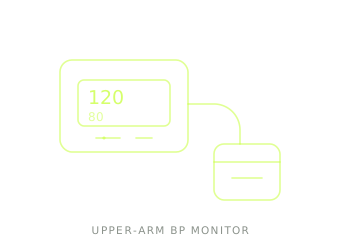
| Validated devices | Omron Platinum (BP5450), Omron Gold (BP7000 series), Withings BPM Connect. Validation lists maintained by the American Heart Association and dabl Educational Trust. |
| Weaker accuracy data | Wrist and finger cuffs perform less accurately than upper-arm cuffs in the validation literature; unvalidated devices have no published accuracy data at all. Cuff fit affects the reading (the cuff must fit the upper arm correctly) standard adult cuff for arm circumference 22-32 cm, large adult cuff for 33-42 cm. |
| Protocol (AHA standard) | Sit quietly for 5 minutes. No caffeine, exercise, or smoking for 30 minutes prior. Back supported, feet flat. Upper arm at heart level. Validated home protocols take 2 readings 1 minute apart and record both. Record both. Morning and evening measurements. |
| Cost | $50 to $100 for a validated upper-arm device. One-time purchase. |
| Target | The 2025 AHA/ACC multisociety guideline classifies blood pressure as normal below 120/80 mmHg; elevated at 120 to 129 systolic with diastolic under 80; stage 1 hypertension at 130 to 139 systolic or 80 to 89 diastolic; and stage 2 hypertension at 140 or above systolic, or 90 or above diastolic. Classification rests on the average of at least two careful readings taken on at least two separate occasions, not on any single measurement. |
| Frequency | Daily monitoring during any medication adjustment. Twice daily (morning and evening) for ongoing hypertension management. Monthly spot-checks for normal blood pressure. |
Morning and evening readings, 3 days in a row, every month or during any medication or supplement change. A useful log holds date, time, reading 1, reading 2, and recent medications and supplements. The log is most useful at physician appointments. Apps: Omron Connect, Apple Health, Blood Pressure Monitor Family Lite.
527 patients with poorly controlled hypertension in 24 general practices were randomized to self-monitoring with self-titration of medication, or to usual care; 480 were analyzed at 12 months. Systolic blood pressure fell more with self-management than with usual care. Leg swelling was more common in the self-management group.
Systematic review A review that searches for every study on a question using a method set in advance, then assesses them together. and meta-analysis of studies comparing home, ambulatory and office readings as predictors of target organ damage such as left ventricular mass. Home blood pressure predicted organ damage as well as ambulatory monitoring and better than office readings. It compares measurement methods; it is not a trial of home monitoring as a treatment.
Position paper of the European Society of Hypertension Working Group on Blood Pressure Monitoring, updating its 2000, 2008 and 2010 recommendations on how home monitoring is done and how it is used in diagnosis and treatment. A consensus document, not a trial.
No safety concerns from the device itself. Blood pressure monitoring is safe for all adults. If readings are consistently above 180/120 mmHg, this is a hypertensive crisis requiring immediate medical attention regardless of symptoms.
Multiple common medications affect blood pressure: antihypertensives (intended effect), NSAIDs (may raise BP), decongestants (pseudoephedrine raises BP), oral contraceptives (may raise BP), stimulants (raise BP), many supplements at high doses. Home monitoring is particularly valuable for detecting medication-induced blood pressure changes.
Blood pressure is EBL's most directly actionable cardiovascular biomarker A measurable sign in the body, such as a blood test value, used to track a condition or the effect of a treatment.. Multiple Grade B and B supplements on this platform have human RCT evidence for blood pressure reduction: magnesium, omega-3, EGCG, coq10, and others. Home monitoring is how you know whether an intervention is actually working for you specifically, not just at the group level.
Educational use only · Not medical advice · Starting, stopping or changing any supplement or medication is a decision for your physician
EBL does not verify the regulatory status of any device. Many consumer wellness devices are not FDA-cleared The FDA found a device substantially equivalent to one already on the market. Clearance is not approval and does not require trials showing benefit., and FDA clearance, where it exists, applies only to specific indications. The grade on this page describes the strength of published human trial evidence in the populations studied. It is not a recommendation for any individual and is not medical advice. Using any device for a health purpose is a decision for your physician.
Primary evidenceTwo papers, each linked to its PubMed record.
Home BP monitoring, especially with co-interventions, modestly lowers blood pressure vs usual care. Agarwal et al. 2011 (Hypertension; PMID 21115879), meta-analysis of 37 RCTs (n=9,446): systolic -2.63 mmHg (95% CI -4.24 to -1.02), diastolic -1.68 mmHg. TASMINH2 (McManus et al. 2010, Lancet; PMID 20619448, RCT n=480) showed self-monitoring with self-titration lowered systolic BP. Endpoint The outcome a trial measures to decide whether the treatment worked, such as heart attacks, blood pressure or a symptom score. is a validated surrogate (BP), not a hard outcome, so the ceiling is B. [Corrects a prior page citation that mis-attributed the 37-RCT figure to Bliziotis 2012 and inflated the effect to -3.9/-2.4.]
This page carries a letter. EBL takes no commission, referral fee or payment of any kind on anything it grades. No letter has been bought and none is for sale. Products listed under this modality may be commercial partners, and their purchase links may earn EBL a commission. Those products carry no letter of their own, every relationship is disclosed beside the link, and where a product does not deliver what the trials tested, this page says so regardless of who pays.
How this is enforced
That is not a promise, it is a build condition. Two checks run on every deploy: one refuses to publish if a commission is claimed on anything graded, the other refuses if a page names a commercial relationship that is not declared in the register. If either fails, this page does not go live. You can read how the checks work, and what they do not cover, on the evidence integrity page.
These statements have not been evaluated by the Food and Drug Administration. Any grade on this page describes the strength of published human trial evidence in the populations studied. It is not a recommendation for any individual and is not medical advice. Starting, stopping or changing any supplement or medication is a decision for your physician.
Grades move when new trials publish. A free monthly email lists every grade EBL moved, with the reason and the trial behind it: the sign-up is on the Evidence Log →