Supplement
Pentadecanoic Acid (C15:0)
LDL Low-density lipoprotein cholesterol, the cholesterol fraction most closely tied to plaque in the arteries. cholesterol lowering in one trial, on top of a weight-loss diet in women with fatty liver disease; not yet replicated The same finding reproduced by a separate research group. A result seen once can be chance or bias; a replicated one is harder to explain away., and no clinical endpoint The outcome a trial measures to decide whether the treatment worked, such as heart attacks, blood pressure or a symptom score. has been tested.
Grade C: human trials exist, but they are small, mixed or not yet repeated. This is not a finding that it does not work. How to read a grade →
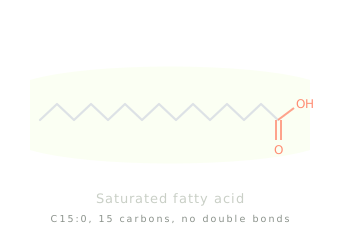
C15:0 is a fat found in dairy products. In one study of women with fatty liver disease who were on a weight-loss diet, adding it lowered LDL cholesterol more than the diet alone. No one has repeated that result. A second study only checked whether blood levels rose. No study has tested it on heart disease or long life.
- Dose studied
- 200 to 300 mg/day (two trials)
- Form graded
- C15:0 (capsule; soymilk in TANGO)
- Cited PMIDs PubMed ID: the permanent number the US National Library of Medicine gives a published paper. Each one links to that paper's record on PubMed.
- PMID 38035997 →PMID 39069269 →
A letter describes the human evidence, not the product, the manufacturer, or the ingredient's worth.
See the full evidence record →Pentadecanoic Acid (C15:0) for LDL cholesterol and liver enzymes, graded on human trial evidence.
Why this gradeGrade C, small or unreplicated trials. The reasoning, and what the grade does not cover.
Close to the line between C and D, and C is the honest letter. Two randomized trials have given C15:0 to people. In one (TANGO) it lowered LDL cholesterol beyond what a weight-loss diet achieved, a surrogate result from a single trial that nobody has repeated. In the other its pre-specified outcome was only whether the blood level rises, and the encouraging liver-enzyme numbers come from splitting the treated group by response, which randomization does not protect. Most of the published C15:0 literature is cell work, animal work and observational Research that watches what people already do rather than assigning a treatment. It can show that two things travel together, not that one causes the other. association with dairy fat intake, none of which enters a grade. A replicated trial on a clinical or functional endpoint at a stated dose would move this record.
WHAT THIS GRADE DOES NOT COVERaging, longevity or cellular health, which are how C15:0 is sold and which no trial has measured. It does not cover the 100 mg retail serving, which is below both studied doses, and the LDL result does not transfer to someone who is not also on a weight-loss diet, because that is the only setting in which it was seen.
A grade describes the human evidence for a named use. It is not advice, and it is not a judgment on any individual prescription. How the letters are decided →
Who responds: this record's trial reading reports no subgroup that identifies who responds.
Sold as a healthy-aging capsule at 100 mg, one or two a day. The trials used 200 to 300 mg, tested liver and cholesterol markers rather than aging, and the LDL result was on top of a weight-loss diet.
A grade describes the intervention that was tested. Where the product on the shelf differs from it, this says so.
How this letter has changed · latest: September 2026 · Added
New record. Two randomized trials have given C15:0 to people. In the TANGO trial (Chooi et al., Am J Clin Nutr 2024; PMID 38035997), 300 mg a day in soymilk lowered LDL cholesterol beyond what a weight-loss diet achieved in 88 women with fatty liver disease. In a 30-person trial of 200 mg a day (Robinson et al., J Nutr 2024; PMID 39069269), the pre-specified outcome was the blood level of C15:0, which rose; the liver-enzyme changes it reported compare responders rather than randomized arms. One surrogate result, not yet repeated, and no clinical endpoint: Grade C. The common retail serving of 100 mg is below both studied doses.PMID 38035997 PMID 39069269
Every change to a letter on this site is dated and published. The full evidence log →
Commercial disclosure
EBL earns no commission on any supplement it grades. Grades are assigned by published rubric before any commercial relationship exists and are never influenced by one. Full disclosure.
200 to 300 mg a day in the two trials (200 mg capsules; 300 mg in fortified soymilk)
The trials used 200 mg and 300 mg a day. A single 100 mg capsule, the common retail serving, is below both studied doses. The TANGO dose was delivered in soymilk rather than a capsule.
In the cited 12-week trial, two 100 mg capsules were taken each morning (PMID 39069269). The summary of the other cited trial does not state a time (PMID 38035997).
Checked against the full report for 1 of the 2 cited studies, and the published summary for the rest. What the cited trials did, not a schedule. Every supplement, by trial timing →
Pregnancy and breastfeeding: not studied. Neither trial ran longer than 12 weeks, so longer-term safety is unmeasured.
No drug interaction has been studied or reported. Neither trial reported a significant adverse event.
No human interaction study located. No drug interaction has been studied for supplemental C15:0. A PubMed search for human interaction, pharmacokinetic or co-administration studies in September 2026 returned 23 records; none tested C15:0 alongside a medication. They are dairy-fat biomarker A measurable sign in the body, such as a blood test value, used to track a condition or the effect of a treatment. studies, a malabsorption test that uses C15:0 as a tracer, and imaging or drug-conjugate chemistry. The record's statement that no interaction has been studied rests on this search. Searched PubMed in September 2026: 1 query, 23 human results.
LDL cholesterol, ALT and AST at baseline and 12 weeks, the endpoints the two trials measured. Plasma C15:0 if available: in the 200 mg trial, only participants whose level passed 5 micrograms per mL showed the liver-enzyme change.
Primary evidenceTwo papers, each linked to its PubMed record.
Chooi et al. (Am J Clin Nutr, 2024; PMID 38035997), the TANGO trial: 88 Chinese women with fatty liver disease were randomized for 12 weeks to an Asian-adapted Mediterranean diet with C15:0, the same diet without it, or their usual diet. C15:0 was given as 300 mg a day in soymilk supplied by a commercial food manufacturer. Both diet arms lost weight and liver fat; adding C15:0 lowered LDL cholesterol further and shifted the gut microbiome. Robinson et al. (J Nutr, 2024; PMID 39069269): 30 young adults with overweight or obesity randomized 2:1 to 200 mg C15:0 a day or placebo An inactive substitute made to look like the real treatment, so participants cannot tell which one they received. for 12 weeks. The primary outcome was the blood level of C15:0, which rose. Lower liver enzymes and higher hemoglobin were seen only in the half of the treated group whose level passed 5 micrograms per mL, a comparison of responders rather than of randomized arms. Grade C: two small trials, one surrogate benefit that has not been repeated, and no clinical endpoint.
Educational use only · Not medical advice · Starting, stopping or changing any supplement or medication is a decision for your physician
These statements have not been evaluated by the Food and Drug Administration. This product is not intended to diagnose, treat, cure, or prevent any disease. The grade on this page describes the strength of published human trial evidence in the populations studied. It is not a recommendation for any individual and is not medical advice. Starting, stopping or changing any supplement or medication is a decision for your physician.
This page carries a letter. EBL takes no commission, referral fee or payment of any kind on anything it grades. No letter has been bought and none is for sale.
How this is enforced
That is not a promise, it is a build condition. Two checks run on every deploy: one refuses to publish if a commission is claimed on anything graded, the other refuses if a page names a commercial relationship that is not declared in the register. If either fails, this page does not go live. You can read how the checks work, and what they do not cover, on the evidence integrity page.
Grades move when new trials publish. A free monthly email lists every grade EBL moved, with the reason and the trial behind it: the sign-up is on the Evidence Log →