Supplement · graded by use, seven uses
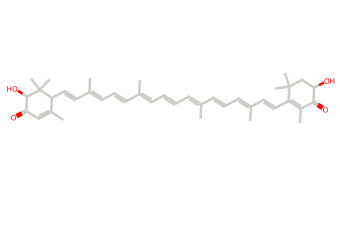
Astaxanthin
Skin moisture and elasticity.
Grade C: human trials exist, but they are small, mixed or not yet repeated. This is not a finding that it does not work. How to read a grade →
Astaxanthin is a red pigment made by algae. It gives salmon its color. Taken at about 6 mg a day, it has been tested for skin. In small studies, skin held moisture better and stayed more elastic. Small studies also looked at wrinkles, sun protection, blood fats, blood pressure, eye strain and muscle soreness after exercise. Each of these rests on small or few studies.
The C belongs to one of the seven uses graded on this record. The other six carry their own letters.
As studied, and the trials
Zhou et al. (Nutrients, 2021; PMID 34578794): moisture SMD 0.53 and elasticity SMD 0.77 against placebo An inactive substitute made to look like the real treatment, so participants cannot tell which one they received. across 9 randomized trials, with high heterogeneity How much the results of the pooled trials differ from each other. High heterogeneity makes a combined estimate less reliable.. Tominaga et al. (Acta Biochim Pol, 2012; PMID 22428137) is one of them. The trials read are manufacturer-affiliated, which is disclosed here. C, not B: skin moisture and elasticity are measured skin markers, not an established stand-in for a clinical outcome, and under the B definition such a marker qualifies for nothing above C (the rule applied to MitoQ's flow-mediated dilation in October 2026). The outside audit of October 2026 also found the positive results rest on within-group change and subsets in manufacturer-run trials.
As studied, and the trials
Zhou et al. (Nutrients, 2021; PMID 34578794) found no pooled effect on wrinkle depth (SMD -0.26, 95% CI -0.58 to 0.06); the only positive wrinkle result is the 36-man arm of Tominaga et al. (Acta Biochim Pol, 2012; PMID 22428137). C.
As studied, and the trials
Ito et al. (Nutrients, 2018; PMID 29941810): the dose of ultraviolet light needed to redden the skin rose and moisture loss after exposure was smaller. One sponsor-run trial of 23 people: C.
As studied, and the trials
Ma et al. (Nutr Res, 2022; PMID 35091276) found malondialdehyde lower; Coombes et al. (Am J Clin Nutr, 2016; PMID 26675778) and Liu et al. (Nutrients, 2026; PMID 42197030) found no change in oxidative markers, and Park et al. (Nutr Metab, 2010; PMID 20205737) was mixed with 14 people per group. Malondialdehyde is not an established stand-in for a clinical outcome. Mixed: C.
As studied, and the trials
Xia et al. (Pharmacol Res, 2020; PMID 32755613) found no effect on LDL Low-density lipoprotein cholesterol, the cholesterol fraction most closely tied to plaque in the arteries. cholesterol, blood pressure or glucose; Leung et al. (Nutrients, 2022; PMID 35631193) found LDL cholesterol lower; Coombes et al. (Am J Clin Nutr, 2016; PMID 26675778) found arterial stiffness unchanged after a year. Pooled analyses disagree: C.
As studied, and the trials
Liu et al. (Nutrients, 2026; PMID 42197030): creatine kinase and lactate dehydrogenase fell, but VO2max The most oxygen the body can use during all-out exercise, a standard measure of aerobic fitness., time trials and power did not improve. Damage markers are not an established stand-in for a clinical outcome: C.
As studied, and the trials
Hecht et al. (Adv Ther, 2025; PMID 40014233): the questionnaire score improved 20% more than placebo; visual acuity and focusing did not differ. One manufacturer-run trial on a mostly self-reported endpoint The outcome a trial measures to decide whether the treatment worked, such as heart attacks, blood pressure or a symptom score.: C.
Read the grade that matches your goal. How EBL grades by use →
A letter describes the human evidence, not the product, the manufacturer, or the ingredient's worth.
See the full evidence record →Skin moisture and elasticity, graded on human trial evidence. Other uses are graded separately.
As studied: dose, form, population and duration for every use
A grade describes the intervention that was tested. Where the product on the shelf differs from it, this says so.
How this letter has changed · latest: October 2026 · Downgraded
Skin moisture and elasticity are measured skin markers, not an established stand-in for a clinical outcome, so under the B definition they qualify for nothing above C; the pooled analysis behind the B (Zhou et al., Nutrients, 2021; PMID 34578794) and the trial in it (Tominaga et al., Acta Biochim Pol, 2012; PMID 22428137) measured those markers. It is the same rule that returned MitoQ's flow-mediated dilation to C in October 2026. Every other use on the record is already C or D, so the headline is C.PMID 34578794 PMID 22428137
The record listed antioxidant activity, eye health, skin photoprotection, cardiovascular support and exercise recovery under one B. A PubMed search and a reading of every cited paper found the B holds only for skin moisture and elasticity (Zhou et al., Nutrients, 2021; PMID 34578794). Each other use is now graded on its own evidence and is C. The descriptions of Tominaga et al. (PMID 22428137) and Park et al. (PMID 20205737) were also corrected: Tominaga's moisture result was a trend, and Park found some inflammatory markers rose at 8 mg.PMID 34578794 PMID 22428137 PMID 20205737
Every change to a letter on this site is dated and published. The full evidence log →
Commercial disclosure
EBL earns no commission on any supplement it grades. A purchase made through the dispensary link below pays EBL nothing, the practitioner discount goes to you in full. The dispensary is Fullscript, a practitioner dispensary, and many of the professional-grade brands in it are sold mainly through practitioners rather than in health food stores. Grades are assigned by published rubric before any commercial relationship exists and are never influenced by one. Full disclosure.
4 to 12 mg/day
Haematococcus pluvialis microalgae is the most studied source.
In the cited immune-response trial, astaxanthin was taken as one softgel every morning (PMID 20205737). The skin trial summary gives 6 mg a day without a time (PMID 22428137). Neither report says it was taken with a meal.
Checked against the full report for 1 of the 2 cited studies, and the published summary for the rest. What the cited trials did, not a schedule. Every supplement, by trial timing →
No prominent contraindication has been identified at the doses studied. One caution follows from the source material rather than from the molecule: astaxanthin is extracted either from algae or from crustacean shells depending on the product, so a crustacean-derived product is a shellfish exposure. The label states which.
Antihypertensives: additive blood-pressure lowering. 5-alpha-reductase inhibition has been reported in laboratory work, which would matter alongside finasteride or dutasteride and has not been measured in people. Otherwise a low interaction profile.
Mechanism-based, no human interaction study located. The drug interactions described for Astaxanthin are mechanism-based. A PubMed search for human interaction, pharmacokinetic or co-administration studies pairing it with antihypertensive returned no results in August 2026. The caution stands on pharmacology, not on a trial, and is labeled as such. Basis: pharmacological mechanism, not a human study. Searched PubMed in August 2026: 1 query, 0 human results.
Skin aging markers, eye health, exercise recovery time, oxidative stress markers (8-OHdG if available)
Primary evidenceTen papers, each linked to its PubMed record.
Zhou et al. (Nutrients, 2021; PMID 34578794): 9 randomized trials of oral astaxanthin; skin moisture and elasticity improved against placebo, wrinkle depth did not. Tominaga et al. (Acta Biochimica Polonica, 2012; PMID 22428137): in the randomized double-blind Neither the participants nor the people assessing them know who received the real treatment until the trial ends. arm, 36 men taking 6 mg a day for 6 weeks, wrinkles, elasticity and water loss through the skin improved and moisture showed only a trend; the paper's other arm was open-label Everyone in the trial knows which treatment they are receiving, so expectations can shape the results, especially for symptoms people report themselves.. The skin trials read are manufacturer-affiliated. Ito et al. (Nutrients, 2018; PMID 29941810): 23 adults, less ultraviolet skin damage, one small trial. Ma et al. (Nutrition Research, 2022; PMID 35091276): 12 trials; malondialdehyde fell, C-reactive protein and tumor necrosis factor did not. Park et al. (Nutrition and Metabolism, 2010; PMID 20205737): 42 young women, 14 per group; a DNA damage marker fell, lipid peroxidation did not change, and some inflammatory markers rose at 8 mg. Coombes et al. (American Journal of Clinical Nutrition, 2016; PMID 26675778): 12 mg a day for a year changed neither oxidative stress markers nor arterial stiffness. Xia et al. (Pharmacological Research, 2020; PMID 32755613): no effect on LDL cholesterol, blood pressure or glucose; Leung et al. (Nutrients, 2022; PMID 35631193): LDL cholesterol lower. Liu et al. (Nutrients, 2026; PMID 42197030): creatine kinase lower after exercise, performance unchanged. Hecht et al. (Advances in Therapy, 2025; PMID 40014233): one manufacturer-run trial in 64 children with screen-related eye strain. The B covers skin moisture and elasticity only.
Educational use only · Not medical advice · Starting, stopping or changing any supplement or medication is a decision for your physician
These statements have not been evaluated by the Food and Drug Administration. This product is not intended to diagnose, treat, cure, or prevent any disease. The grade on this page describes the strength of published human trial evidence in the populations studied. It is not a recommendation for any individual and is not medical advice. Starting, stopping or changing any supplement or medication is a decision for your physician.
Who responds: this record's trial reading reports no subgroup that identifies who responds.
This page carries a letter. EBL takes no commission, referral fee or payment of any kind on anything it grades. No letter has been bought and none is for sale.
How this is enforced
That is not a promise, it is a build condition. Two checks run on every deploy: one refuses to publish if a commission is claimed on anything graded, the other refuses if a page names a commercial relationship that is not declared in the register. If either fails, this page does not go live. You can read how the checks work, and what they do not cover, on the evidence integrity page.
How EBL searched for the trials (1 search)
The search that was run, what it returned, and what was left out and why, so the absence of evidence can be checked as well as its presence.
astaxanthin[tiab] AND (meta-analysis[pt] OR randomized controlled trial[pt])Grades move when new trials publish. A free monthly email lists every grade EBL moved, with the reason and the trial behind it: the sign-up is on the Evidence Log →