BFR training is contraindicated in individuals with deep vein thrombosis, severe peripheral artery disease, open wounds at the cuff site, or certain cardiac conditions. Start with a trained practitioner. The limb occlusion pressure (LOP) should be individually calibrated — blanket cuff pressures are not safe for all users.
BFR Training
Blood flow restriction training exploits the physiology of metabolic fatigue to produce anabolic signaling at loads far below what conventional resistance training requires. By partially occluding venous outflow from a working limb, BFR forces the recruitment of fast-twitch type II muscle fibers — the fibers most responsible for strength and hypertrophy — even at 20–30% of one-rep maximum. The resulting cascade of mTORC1 activation, local IGF-1 release, and systemic growth hormone secretion mirrors the anabolic signaling of heavy lifting, without the joint loading. For older adults managing sarcopenia, recovering from surgery, or unable to tolerate conventional resistance training loads, this distinction is clinically meaningful: the evidence now supports BFR as a primary — not merely supplementary — muscle-preservation modality.

BFR applies a pneumatic or elastic cuff to the proximal limb, partially restricting venous return (70–80% LOP) while maintaining arterial inflow. The resulting metabolic stress, muscle cell swelling, and fast-twitch fiber recruitment triggers mTORC1 activation, IGF-1 local release, and growth hormone secretion — the same anabolic signaling cascade that heavy lifting stimulates, at 20–30% of the load.
A 2019 meta-analysis (Lixandrao et al., Sports Med, 19 RCTs) found BFR training produced 87% of the hypertrophy gains of high-load training across all age groups. In older adults specifically, a 2021 meta-analysis (Centner et al., Sports Med, 24 RCTs) found BFR superior to low-load training alone and non-inferior to high-load training for muscle cross-sectional area.
Educational ranking only. Not medical advice. Evidence grade refers to published human research on this ingredient — not proof that any specific product treats or prevents disease. Affiliate links may generate revenue but never affect ratings.
Educational comparison only. Not medical advice. Pricing is approximate and subject to change. Device descriptions reflect published validation data and publicly available specifications. Links are provided for informational purposes only.
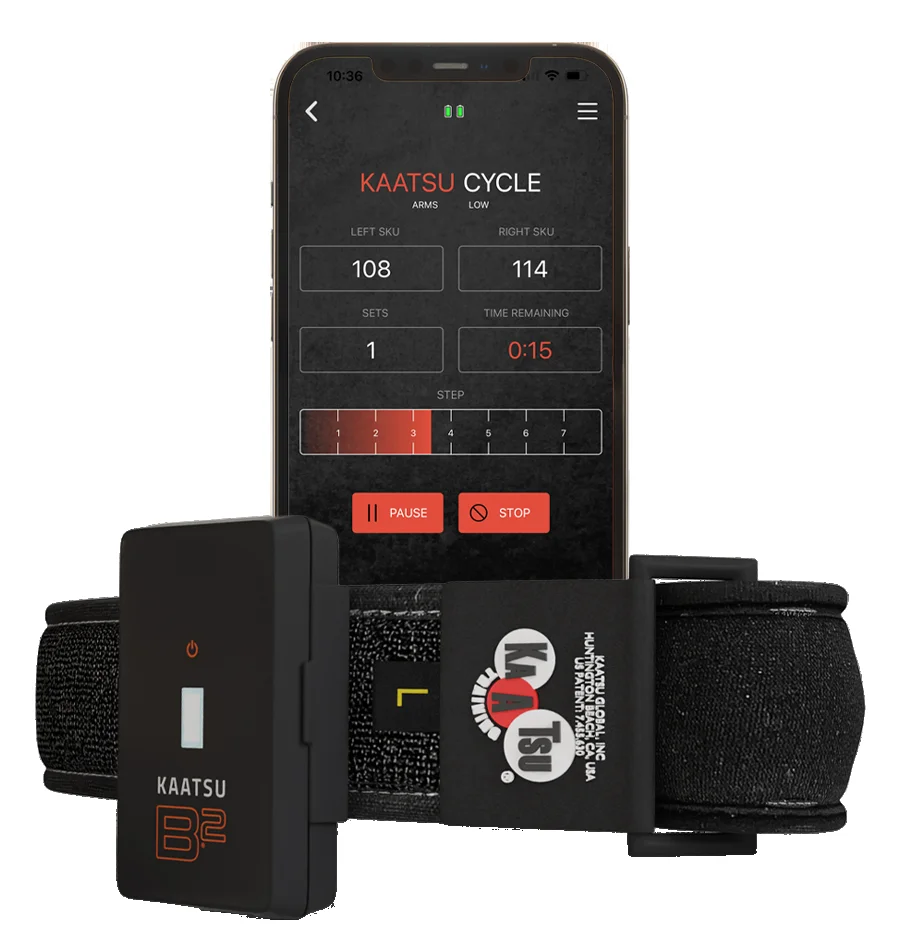
KAATSU Global
KAATSU is the original BFR system, developed by Yoshiaki Sato in Japan in the 1970s and the device most cited in peer-reviewed BFR literature. The system uses pneumatic cuffs with computerized pressure control, offering both a KAATSU Cycle mode (pulsing pressure for beginners and rehabilitation) and KAATSU Training mode (sustained occlusion for hypertrophy protocols). A 2021 NASA-funded study validated KAATSU specifically for muscle preservation under microgravity conditions, extending its evidence base beyond conventional exercise settings. The KAATSU Master and KAATSU Nano connect via Bluetooth for pressure tracking across sessions. FDA 510(k) cleared for exercise use. The cost is the primary barrier — the Master unit runs approximately $1,500 and the Nano approximately $650 — but for practitioners or individuals for whom clinical validation is non-negotiable, no other consumer BFR device has an equivalent evidence record.
The research-grade choice. If cost is not a constraint and clinical validation matters, KAATSU is the standard against which other BFR devices are measured.
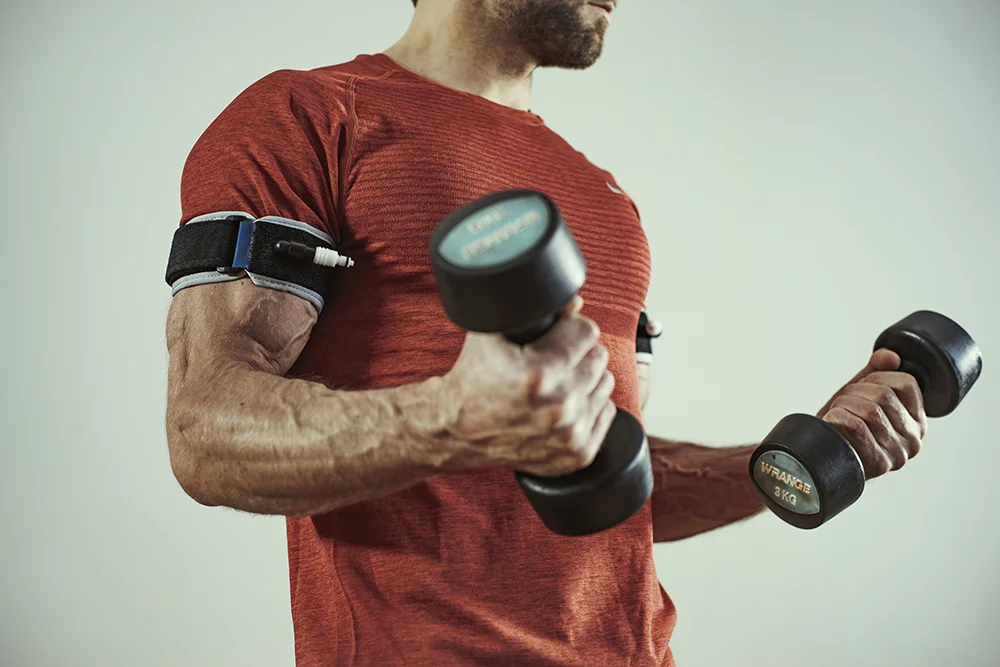
B Strong BFR Training System
B Strong uses an elastic band system rather than pneumatic cuffs, with proprietary pressure guidelines calibrated to band size and tightness. The system allows four-limb simultaneous BFR — a protocol used in the published B Strong research to maximize systemic hormonal response from a single training session. The system was co-developed with Jim Stray-Gundersen, the physiologist who served as the Norwegian Olympic team's altitude training specialist and has authored peer-reviewed BFR research. At approximately $299–$349 for the full kit, B Strong is the most widely cited non-pneumatic BFR system in the research literature with a published safety and efficacy record. The practical trade-off is pressure consistency: elastic band pressure varies with limb position and skin contact, meaning you cannot achieve the same precision as a calibrated pneumatic system. For daily home use and users who cannot justify a $650–$1,500 pneumatic device, B Strong is the evidence-supported alternative.
Best value for home users. The elastic band approach means pressure varies with limb position — less precise than pneumatic but more practical for daily use. Comes with a structured training protocol.
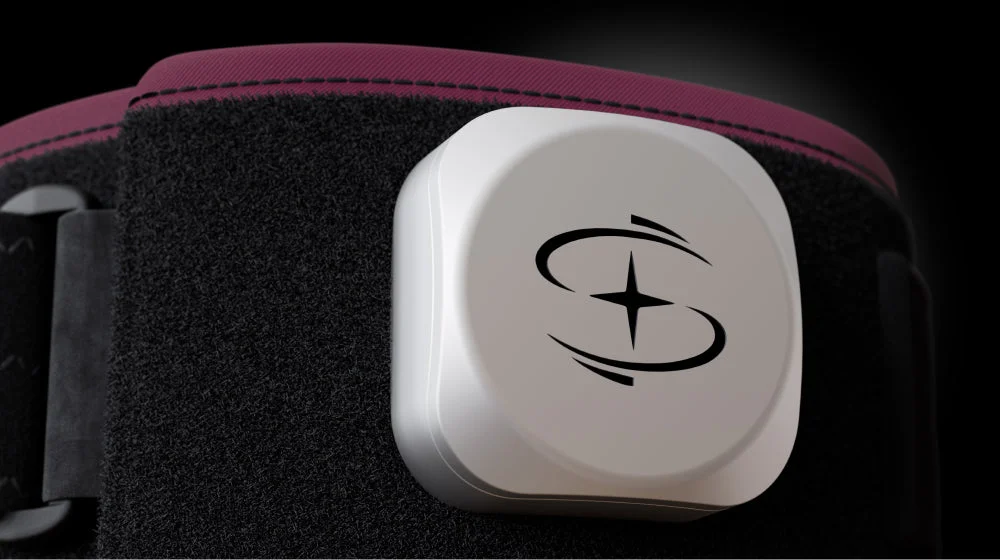
Delphi BFR SmartCuffs
SmartCuffs are the most widely deployed pneumatic BFR system in US physical therapy clinics. The system uses automated LOP detection — the cuff inflates and detects when arterial inflow is fully occluded, then sets the training pressure as a calculated percentage of that individual measurement — validated against Doppler ultrasound for LOP accuracy. The iOS app tracks session data, training percentages, and patient history across multiple users. The clinical kit runs approximately $1,200–$1,800 depending on configuration. SmartCuffs are particularly well-suited for post-surgical rehabilitation settings where each patient's vascular anatomy differs meaningfully and where using a standardized pressure rather than an individually calibrated LOP percentage would introduce unacceptable variability. The Delphi system offers the most rigorous LOP calibration workflow of any device in this comparison.
Best for clinical use and rehab settings where precise LOP calibration per patient is non-negotiable. Overspecified for home use; well-matched for physical therapists treating older adults post-surgery.
One research-grounded briefing per week. No hype, no affiliate push, no AI-generated filler.
Educational ranking only. Not medical advice. Evidence grade refers to published human research on this modality — not proof that any specific device treats or prevents disease. Links to devices are provided for informational purposes only.